
Personal information scraping is the automated collection and aggregation of your data by companies known as data brokers, who legally gather and trade detailed profiles about you without your direct consent. This practice is not a fringe activity. Over 4,000 registered data brokers operate in the United States alone, and the average American adult has personal profiles sitting on 50 to 100 or more data broker sites. Understanding why personal info gets scraped online starts with recognizing that most of this collection is entirely legal, built on public records, commercial transactions, and the fine print you agreed to without reading. The data broker industry treats your personal information as a commodity, and the market for it is enormous.
Why personal info gets scraped online: the data broker machine
The core reason your personal information gets scraped online is economic. Data brokers profit by building detailed profiles and selling them to marketers, insurers, employers, and anyone else willing to pay. Your name, address, phone number, and email address are worth money because they are stable, verifiable, and useful for targeting. The more complete a profile, the more it sells for.
Data brokers pull from a wide range of sources simultaneously. Public government records form the foundation. Voter registration rolls, property deeds, court filings, and business licenses are all publicly accessible. Public records serve as the base layer of nearly every broker profile, and brokers have automated systems that ingest these records continuously.

Commercial data layers on top of that foundation. Every time you sign up for a loyalty card, register a warranty, or make a purchase online, that transaction generates a data point. Loyalty cards, purchase data, and app permissions feed directly into broker databases, revealing behavioral signals that advertisers and fraudsters both find valuable. You are not just buying groceries. You are generating a behavioral record.
Web scraping tools add another layer. Automated bots crawl social media profiles, forums, review sites, and public directories to extract names, locations, job titles, and relationship data. The global scraping software market is growing at over 18% CAGR through 2030, which reflects how central automated data collection has become to business operations worldwide. Social media platforms technically prohibit mass scraping in their terms of service, but enforcement is inconsistent.
Mobile apps complete the picture. Many free apps embed software development kits, known as SDKs, that harvest your phone’s location history, contact list, and usage patterns. This data flows to upstream aggregators before reaching the brokers whose sites you might actually find in a search.
Pro Tip: Review app permissions on your phone quarterly. Revoke location access for any app that does not need it to function. This cuts off one of the most persistent data streams feeding broker profiles.
How do data brokers aggregate and use scraped personal information?
Raw data from individual sources is not particularly useful on its own. The real value comes from stitching it together. Personal information is combined into profiles using reliable identifiers like your email address and phone number. These identifiers act as keys that link records from different sources into a single, detailed profile about you.
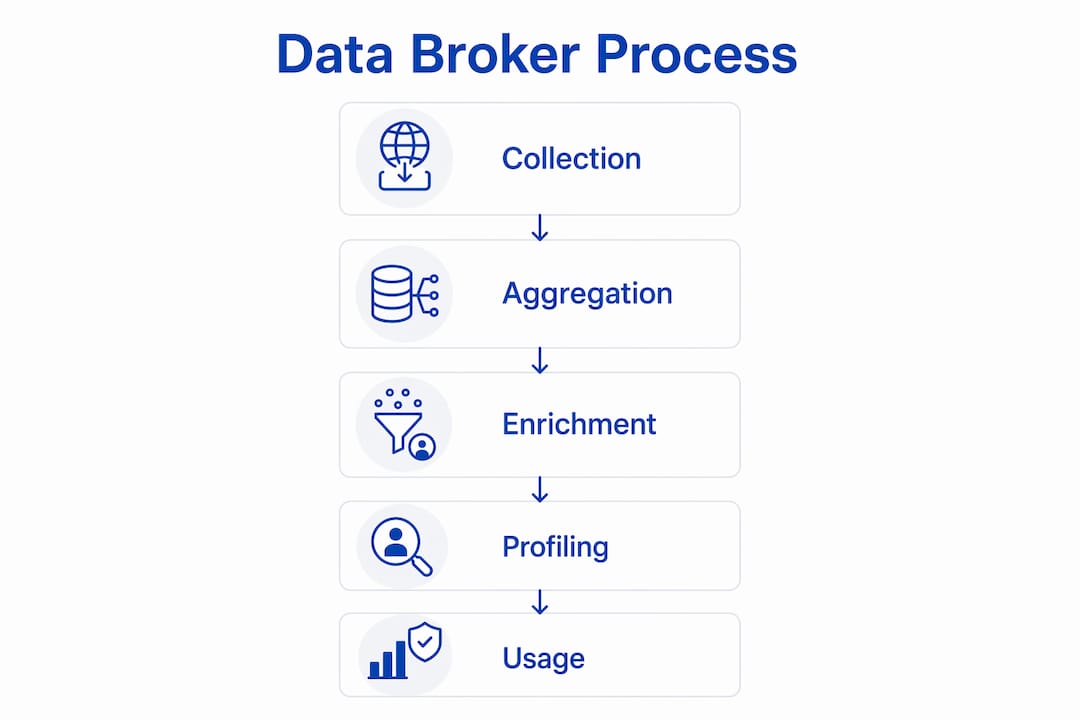
The data broker supply chain has two main tiers. Upstream aggregators collect and compile raw data from the sources described above. Downstream resellers purchase that compiled data and repackage it for specific markets. This supply chain structure is why removing your data from one site rarely solves the problem. The upstream supplier simply resupplies the record.
The uses of scraped data span a wide spectrum:
- Targeted marketing. Advertisers buy profiles to serve personalized ads based on your income range, purchase history, and inferred interests.
- Credit and risk scoring. Some financial and insurance companies use broker data to supplement formal credit checks.
- Background screening. Employers and landlords use people-search sites that draw directly from broker databases.
- Fraud and scam operations. Criminals purchase profiles to run personalized phishing attacks, impersonation scams, and social engineering schemes.
Data broker profiles often contain more detailed life history data than data breach compilations. Legal collection methods, including past addresses, gym memberships, and subscription histories, produce richer records than most hacks ever could.
The sensitive nature of what brokers compile is striking. Data brokers compile portfolios including geolocation, political views, and sexual identity, often without individuals ever knowing a profile exists. These are not just contact details. They are intimate portraits assembled from your daily life.
Why is personal information specifically targeted and what are the consequences?
Personal information is targeted because it is financially valuable and relatively easy to collect legally. Stable identifiers like your email address and phone number are particularly prized because they persist across years and link records from dozens of sources. A single verified email address can unlock a profile spanning a decade of your behavior.
The consequences of this targeting fall into several categories:
- Personalized scam attacks. Scammers primarily acquire detailed profiles from data brokers rather than hacking or dark web sources. When a caller already knows your address, your family members’ names, and your recent purchases, the scam feels credible.
- Identity fraud. Detailed profiles make it easier to answer security questions, impersonate you to financial institutions, or open accounts in your name.
- Profiling and discrimination. Inferred attributes like political affiliation or health conditions can affect how companies treat you, even when those inferences are wrong.
- Privacy erosion. The sheer persistence of scraped data means your information circulates long after you have moved, changed jobs, or tried to remove it.
The data broker industry lacks effective safeguards, with minimal vetting of who purchases profiles. That gap between collection and accountability is where most of the harm originates. You do not need to be a public figure to be a target. Volume is the point. Brokers profit from scale, not selectivity.
The long-term persistence of scraped data compounds every other risk. Once your information enters the broker ecosystem, it replicates across dozens of databases. Correcting it at the source does not automatically correct it downstream.
How can you reduce your personal info exposure from scraping?
Reducing your exposure requires a multi-step approach, and realistic expectations matter here. A professional first-pass opt-out can eliminate 85–90% of online exposure within two weeks, but that figure drops over time without follow-up. Data reappears because upstream aggregators continue to resupply records to downstream brokers.
The table below compares two common approaches to managing data broker exposure:
| Approach | Effectiveness | Effort required | Long-term result |
|---|---|---|---|
| Manual self opt-out | Moderate | Very high | Inconsistent without ongoing effort |
| Professional removal service | High (85–90% initial) | Low for the individual | Requires quarterly monitoring to maintain |
Removing data from upstream aggregators is the highest-leverage action you can take. Targeting only the consumer-facing people-search sites without addressing the aggregators that feed them produces temporary results at best.
Data deletion requests must be precisely tailored because brokers handle data differently depending on whether they collected it directly or purchased it. Some brokers will only delete data they collected themselves, requiring you to send separate requests for purchased records. This legal nuance is one reason professional services outperform DIY efforts.
Quarterly monitoring is not optional if you want sustained results. New records appear as public databases update, as you make new purchases, or as apps share fresh data. A single removal effort is a starting point, not a finish line.
Pro Tip: Minimize future data availability by using a dedicated email address for loyalty programs and online purchases. This limits the linking power of your primary email as a profile key across broker databases.
For creators managing their digital identity and privacy, the stakes are even higher. Public-facing profiles generate more scraped data, and that data can be weaponized through deepfakes, impersonation, and targeted harassment.
Key takeaways
Personal information gets scraped online primarily because data brokers profit from legally collecting, aggregating, and reselling your data across a multi-tier supply chain that requires continuous, targeted removal efforts to manage.
| Point | Details |
|---|---|
| Data brokers are the core mechanism | Over 4,000 U.S. brokers legally compile and sell personal profiles without your direct consent. |
| Multiple sources feed every profile | Public records, loyalty cards, web scraping, and mobile SDKs all contribute to a single profile. |
| Stable identifiers are the most valuable | Your email and phone number link records across dozens of databases, making them prime targets. |
| Removal requires ongoing effort | An 85–90% initial reduction is achievable, but quarterly monitoring is necessary to prevent reappearance. |
| Scammers use brokers, not hackers | Most personalized scam attacks draw from legally purchased broker profiles, not data breaches. |
What I have learned working in digital identity protection
The most common misconception I encounter is that people assume their data was stolen. The reality is harder to accept: most of it was given away legally, buried in privacy policies and commercial agreements that nobody reads. Fear of hackers misses the nuance entirely. The broker ecosystem is not a black market. It is a legitimate industry operating in plain sight.
What surprises people most is how detailed broker profiles actually are. Past addresses, gym memberships, magazine subscriptions, political donation records. These profiles often contain more personal history than a data breach ever would, precisely because legal collection methods are thorough and continuous.
Removal is real, but it is not a one-time fix. I have seen people complete a full opt-out campaign and feel relieved, only to find their data back on multiple sites within three months. The upstream supply chain keeps feeding the downstream sites. Managing this requires treating it like a recurring task, not a solved problem.
The most productive mindset is active management rather than passive frustration. You cannot eliminate every trace, but you can reduce your exposure significantly and make yourself a harder target. That shift in thinking, from victim to manager, is where real privacy protection begins.
— Sidenty
Professional digital identity protection for data scraping concerns
Understanding the data broker ecosystem is the first step. Acting on that understanding is where most people get stuck, because the process is complex, time-consuming, and never truly finished.
Sidenty specializes in digital identity protection for individuals who need more than a one-time opt-out. With a 99.8% success rate in content removal and a dedicated team of legal experts, Sidenty handles the ongoing monitoring, targeted removal requests, and supply-chain-level intervention that keeps your exposure low over time. For creators facing additional risks like deepfakes or leaked content, Sidenty’s deepfake removal service addresses the full scope of identity threats that scraped data can enable. Your information is out there. Managing it professionally makes a measurable difference.
FAQ
What exactly is web scraping of personal information?
Web scraping of personal information is the automated extraction of your data from public websites, social media, and directories by bots or data broker systems. The industry term is “data harvesting,” and it feeds directly into broker profile databases.
Why do scammers already know my personal details?
Scammers acquire detailed profiles from data brokers rather than hacking systems. Broker profiles include your address, family members, and purchase history, making scam calls and emails feel credible.
Can I get my personal data removed from broker sites?
Yes, but removal requires targeting both downstream people-search sites and the upstream aggregators that supply them. Data deletion requests must be precisely tailored to each broker’s collection method, and quarterly follow-up is necessary.
Is data scraping legal?
Most data broker activity is legal in the United States. Brokers collect from publicly accessible records and commercial data streams, operating within existing privacy laws. Regulations like the California Consumer Privacy Act give residents some opt-out rights, but federal protections remain limited.
How do data brokers get information without my knowledge?
Brokers compile profiles from public records, loyalty programs, and app permissions without requiring your direct interaction. Every public record filing, retail transaction, and app install contributes data that flows into broker databases automatically.