
Online identity verification is the process of confirming that someone is who they claim to be by using digital checks of government-issued IDs and biometric data. Known formally as identity proofing or IDV, this process protects individuals and businesses from fraud, synthetic identity theft, and unauthorized account access. Modern systems support 5,500+ ID document types from over 200 countries and territories, making global verification both practical and consistent. Technologies like Optical Character Recognition (OCR), biometric face matching, and liveness detection power the process, while regulatory standards like NIST SP 800-63A-4 define the compliance framework businesses must follow.
What is identity verification online, and how does it work step by step?
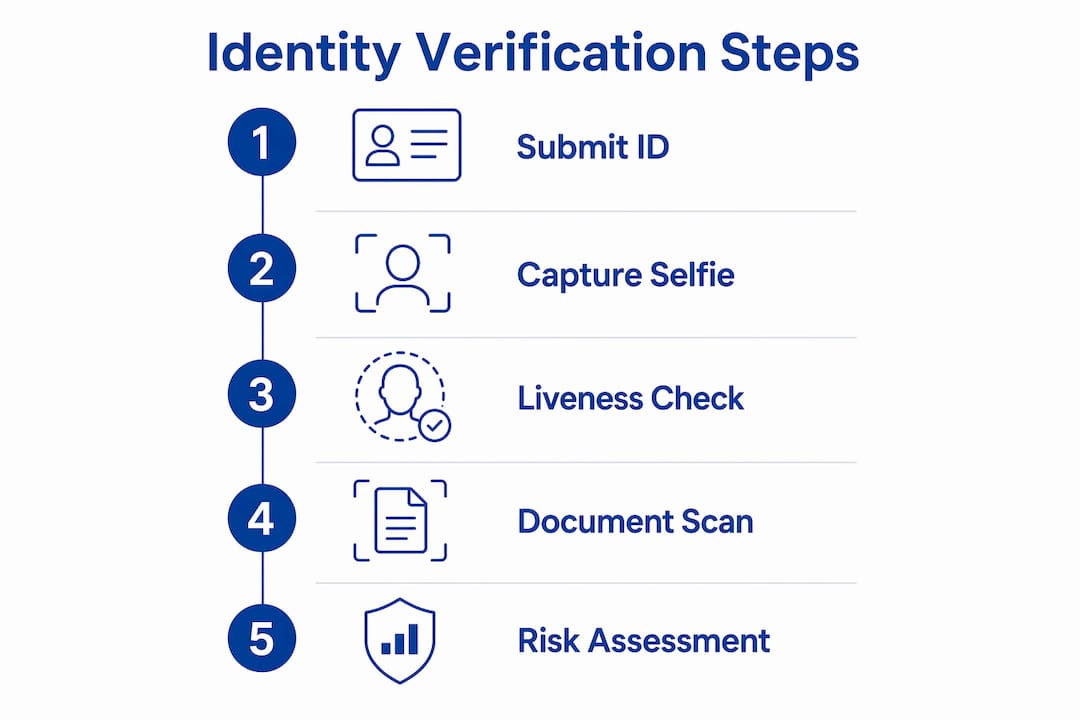
The online identity verification process follows a clear sequence of checks. Each step builds on the last, creating a layered security model that is harder to fool than any single check alone.
Data submission. You upload a photo of a government-issued ID, such as a passport or driver’s license, along with your personal details. The system captures this data as the starting point for all subsequent checks.
OCR data extraction. OCR technology reads the text on your ID automatically, pulling out your name, date of birth, document number, and expiration date. This eliminates manual entry errors and speeds up the process.
Document authenticity check. The system scans your ID for physical security features like holograms, watermarks, and microprinting. It also checks for signs of digital tampering, such as inconsistent fonts or altered pixel patterns.
Biometric verification. You take a selfie or record a short video. The system compares your face to the photo on your ID using facial recognition algorithms. Liveness detection confirms you are physically present, not a printed photo or a pre-recorded video.
Database cross-referencing. Your submitted data is checked against trusted external databases, which may include government records, credit bureau files, or watchlists required under Know Your Customer (KYC) and Anti-Money Laundering (AML) regulations.
Final decision. The system generates a risk score based on all collected signals. Multiple verification factors feed into a weighted model, so no single borderline result automatically causes a rejection. You receive an approval or a request for additional review.
NIST SP 800-63A-4 guidelines confirm that this entire process typically completes in 1–2 minutes, which is significantly faster than traditional in-person verification methods.
Pro Tip: Take your ID photo in natural daylight and lay the document flat on a dark, non-reflective surface. This single step prevents the majority of document scan failures.

What technologies make online identity checks reliable and safe?
The reliability of any IDV system depends on the quality of the technologies running underneath it. Several distinct layers work together to produce a trustworthy result.
OCR for data extraction. OCR converts the printed text on your ID into machine-readable data. Modern OCR engines handle multiple fonts, languages, and document layouts with high accuracy, reducing the chance of misread characters.
Document security feature analysis. Systems examine holograms, UV-reactive inks, and embedded chips where present. This analysis detects forgeries that look convincing to the human eye but fail under algorithmic scrutiny.
Biometric face matching and liveness detection. Facial recognition compares your selfie to your ID photo using geometric measurements of facial features. Liveness detection goes further by requiring real-time interaction, such as blinking or turning your head. Liveness detection meets iBeta Level 3 standards to block deepfakes and injection attacks.
Encrypted data transmission and storage. Your personal data travels over encrypted channels and is stored with access controls. Compliance with GDPR and CCPA requires providers to handle this data with strict privacy protections.
Risk-based scoring models. Rather than a binary pass or fail, a weighted aggregation of document authenticity, biometric match quality, device signals, and behavioral analytics produces a final risk score. This approach improves accuracy when one factor is borderline.
For businesses operating in B2B environments, pairing IDV with a SaaS security checklist helps ensure that identity checks integrate cleanly with broader access control policies.
Pro Tip: When evaluating an IDV provider, ask specifically whether their liveness detection is certified to iBeta Level 2 or higher. Uncertified systems are significantly more vulnerable to spoofing attacks.
Why is the importance of identity verification growing for individuals and businesses?
Identity verification is no longer optional for most organizations. Fraud has grown more sophisticated, and regulators have responded with stricter requirements that affect nearly every industry handling personal or financial data.
Fraud prevention. IDV moves organizations from a “trust everyone” model to a “verify first” model. Synthetic identity fraud, where criminals combine real and fabricated data to create new identities, is particularly difficult to catch without automated verification. Robust IDV catches these cases at the point of onboarding.
Regulatory compliance. KYC, AML, and Customer Identification Program (CIP) regulations require businesses in finance, healthcare, and other regulated sectors to verify customer identities before providing services. NIST’s tiered Identity Assurance Levels let businesses calibrate verification rigor to the sensitivity of the service, from a basic social media sign-up to access to government health records.
Customer trust. Verified transactions signal to customers that a platform takes security seriously. This matters especially for financial services, healthcare portals, and content platforms where users share sensitive personal information.
Faster onboarding. Automated IDV replaces paper-based processes that once took days. Completing verification in under two minutes reduces drop-off rates and lowers operational costs for businesses.
Protection against identity theft. For individuals, completing IDV on a platform confirms that no one else can fraudulently open an account in your name. Sidenty’s work in digital identity protection shows how exposure on the dark web often precedes account takeover attempts, making proactive verification a critical defense layer.
What are common challenges in completing online identity verification?
Even well-designed IDV systems fail when users submit poor-quality inputs. Understanding the most common failure points helps you get through verification on the first attempt.
Poor lighting during selfie capture. Biometric selfie capture requires good, even lighting with no harsh shadows across your face. Dim rooms or strong backlighting cause false negatives and trigger manual review queues.
Submitting photocopies instead of original documents. Secure providers require a valid, unexpired government-issued photo ID in its original form. A photocopy, even a high-quality one, lacks the physical security features the system scans for and will be rejected immediately.
Wearing obstructive items. Hats, sunglasses, or heavy filters on your selfie interfere with facial recognition. The system needs a clear, unobstructed view of your face to make an accurate biometric match.
Unstable internet connections. Real-time biometric checks require a consistent data stream. A dropped connection mid-verification can corrupt the submission and force you to restart.
Ignoring provider instructions. Each IDV provider has specific requirements for document orientation, file format, and lighting. Clear instructions and privacy assurances from providers significantly reduce user errors and drop-off rates. Read them before you start.
Businesses building IDV flows should also review technical validation requirements for EU compliance, particularly when onboarding users across different regulatory jurisdictions.
Pro Tip: Complete your identity verification on a smartphone rather than a laptop. Phone cameras are optimized for portrait capture and produce sharper, better-lit images than most built-in webcams.
Key Takeaways
Online identity verification is the most effective defense against synthetic identity fraud, and its reliability depends entirely on the quality of OCR, biometric liveness detection, and risk-based scoring working together.
| Point | Details |
|---|---|
| IDV is a layered process | OCR, document scanning, biometric matching, and risk scoring all combine to produce a final decision. |
| Liveness detection blocks deepfakes | Systems certified to iBeta Level 3 detect injection attacks that static image checks miss entirely. |
| Regulatory compliance drives adoption | KYC, AML, and NIST SP 800-63A-4 standards require verified identity before access to sensitive services. |
| User errors cause most failures | Poor lighting, photocopies, and unstable connections account for the majority of verification rejections. |
| Verification completes in 1–2 minutes | Automated IDV is dramatically faster than traditional in-person methods and reduces onboarding costs. |
What I’ve learned watching identity fraud evolve
Fraud has not just grown in volume. It has grown in patience. The synthetic identity attacks we see today are not smash-and-grab attempts. They are slow-burn operations where criminals build credit histories over months before cashing out. That shift changes everything about how you need to think about verification.
The biggest mistake I see individuals and businesses make is treating IDV as a one-time gate. You verify once at sign-up and assume the problem is solved. But identity data gets compromised continuously. A credential stolen today may not be used for six months. Ongoing monitoring matters as much as the initial check.
The second thing I have noticed is that user experience and security are not opposites. Providers who invest in clear, plain-language instructions and transparent privacy disclosures see dramatically lower drop-off rates. When users understand why they are being asked for a selfie, they comply more carefully. That cooperation produces better biometric data, which produces more accurate results. Transparency is a security feature.
The future of IDV points toward continuous, passive verification rather than discrete check-in moments. Behavioral analytics, device fingerprinting, and step-up authentication will make the experience less intrusive while raising the bar for fraudsters. The goal is verification that happens around you, not to you.
— Sidenty
How Sidenty protects your digital identity beyond verification
Understanding how identity verification works is the first step. Knowing what to do when your identity is already at risk is the next one.
Sidenty specializes in protecting digital identities after the point of exposure, with a 99.8% success rate in removing unauthorized content, deepfakes, and leaked personal data from platforms across the web. Whether you are a content creator dealing with impersonation or a business facing synthetic identity fraud, Sidenty’s legal and technical team acts fast. Visit Sidenty’s digital identity protection guide for expert best practices, or go directly to Sidenty’s identity protection services to speak with a specialist about your situation.
FAQ
What is identity verification online in simple terms?
Online identity verification is the digital process of confirming that a person is who they claim to be, using a government-issued ID and a biometric check like a selfie. The process typically completes in 1–2 minutes.
What documents do I need to verify my identity online?
You need a valid, unexpired government-issued photo ID in its original form, such as a passport or driver’s license. Photocopies are rejected because they lack the physical security features that verification systems scan for.
How do identity verification methods online prevent fraud?
IDV systems use OCR, document security scanning, biometric liveness detection, and risk-based scoring to catch forged documents, deepfakes, and synthetic identities before they gain access to a platform or service.
Is my personal data safe during online identity checks?
Regulated IDV providers encrypt your data during transmission and storage, and comply with standards like GDPR and CCPA. Always confirm a provider’s privacy policy before submitting any personal information.
How long does the online identity verification process take?
Most automated IDV systems complete the full process in 1–2 minutes. Cases flagged for manual review take longer, typically because of poor image quality or a borderline biometric match.