
Your digital footprint is defined as the complete trail of data you leave behind every time you go online, and it is the primary attack vector threat actors use to plan targeted cyberattacks. Every social media post, forum comment, app login, and cookie accepted adds to this trail. Security professionals distinguish between two types: active footprints, which you create intentionally, and passive footprints, which platforms and data brokers collect without your direct input. The role of digital footprint in security has never been more critical. Attackers no longer need to breach your network to learn about you. They simply read what you have already made public.
How do attackers use digital footprints in cyber attacks?
Threat actors treat your digital footprint as a reconnaissance map. They collect job titles, workplace relationships, technology tools you use, and personal details long before they send a single phishing email. This process is called Open-Source Intelligence, or OSINT, and it requires no hacking. Everything an attacker needs is often already public.

The MITRE ATT&CK framework formally documents this under reconnaissance tactics T1593 and T1589. These tactics cover searching open websites, social media, and public databases to build a detailed profile of a target. The framework’s existence confirms that footprint exploitation is not a fringe tactic. It is a documented, repeatable attack method.
Once a profile is built, attackers use it in several ways:
- Spear phishing: A personalized email that references your employer, a recent project, or a colleague’s name. Because it feels familiar, you are far more likely to click.
- Credential stuffing: Attackers take email and password combinations from old data breaches and test them against your current accounts. If you reused a password from a forgotten forum account, they are in.
- Pretexting: An attacker calls your bank or phone carrier, armed with your address, date of birth, and last four digits of your Social Security number, all gathered from public records and data broker sites.
- Social engineering: Using details from your LinkedIn or Instagram to impersonate a trusted contact and request sensitive information or a wire transfer.
“Threat actors conduct reconnaissance months before an attack, mapping relationships and technical infrastructure using public data alone. Current security models often lack visibility into these external exposures entirely.”
The most dangerous part of this process is its invisibility. No alarm goes off when someone reads your LinkedIn profile or searches your name on a data broker site. By the time an attack lands, the attacker already knows you better than your own IT department does.
What are the security risks of unmanaged digital footprints?
An unmanaged digital footprint is an open door. Identity theft and account takeover risks rise sharply when attackers can pull your data from social media check-ins, public records, and data broker profiles. Most people are unaware that passive data collection, including cookies and tracking pixels, contributes directly to this exposure.
The risks break down into several categories:
- Account takeover: Attackers use harvested credentials and security question answers to reset passwords and lock you out of your own accounts.
- Identity theft: Your name, address, and personal details, combined with breach data, are enough to open fraudulent credit lines or file false tax returns.
- Phishing susceptibility: The more public information available about you, the more convincing a targeted phishing message becomes.
- Old account vulnerabilities: Abandoned accounts with weak security become reliable entry points. Attackers harvest credentials or background data from these forgotten profiles to bypass security questions on your active accounts.
The risks extend beyond direct cyberattacks. A large digital footprint damages reputation, affects job prospects, and exposes children and family members to real-world safety risks. Posts and comments can live indefinitely through caches, archives, and screenshots, even after you delete the original. You lose control of your personal narrative the moment that data leaves your hands.
The passive data problem is especially underestimated. Data brokers compile profiles from public records, purchase histories, and location data, then sell them to anyone willing to pay. You never opted in. You may not even know the broker exists. Yet your home address, phone number, and family relationships are listed there, ready for any attacker to find.
How can you manage and reduce your digital footprint?
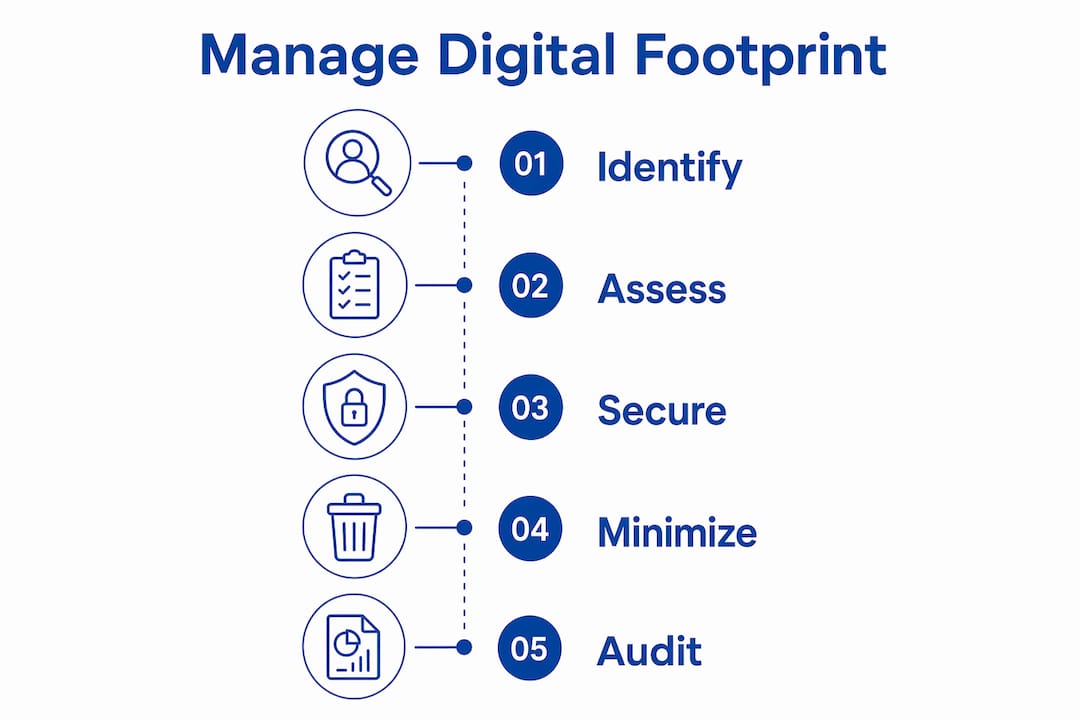
Proactive management is the most effective defense against footprint-based attacks. The five-step digital footprint management lifecycle gives you a clear process to follow.
- Identify your assets. Search your name, email addresses, and usernames across Google, data broker sites, and social platforms. Use Google’s “site:” operator to find indexed pages tied to your identity. This step reveals how much of your information is already public.
- Confirm ownership. Determine which accounts and profiles you actually control. Many people discover old forum registrations, defunct email accounts, or social profiles they forgot existed.
- Assess necessity. Ask whether each account or piece of public information serves a current purpose. If it does not, it is a liability.
- Secure active exposures. Enable multi-factor authentication on every account that supports it. Use a password manager to generate unique, strong passwords for each service. Review privacy settings on social platforms and restrict public visibility wherever possible.
- Remove unnecessary trails. Delete unused accounts. Submit opt-out requests to data brokers. Request removal of your information from people-search sites. Monthly and quarterly audits help you catch new exposures before attackers do.
Pro Tip: Security questions are weak secondary passwords when you answer them truthfully. Your pet’s name or your mother’s maiden name are often exposed through your own social media posts. Use false, memorable answers instead, and store them in your password manager.
Minimizing passive data exposure requires deliberate habits. Reject non-essential cookies when given the choice. Use a privacy-focused browser or extension to block tracking pixels. Avoid logging into third-party apps with your Google or Facebook account, since each connection expands your footprint. Check the privacy risks you face online to understand which data points are most commonly exploited.
For a structured starting point, the content creator privacy checklist from Sidenty covers the key steps in plain language, even if you are not a creator.
What emerging trends are shaping digital footprint protection?
The security industry is shifting its focus from protecting internal networks to managing external exposure. Perimeter security, firewalls, and endpoint protection remain necessary, but they do not address the threat that lives outside your network in public data. Relying solely on perimeter security is insufficient when attackers build attack plans entirely from public information.
Two disciplines now address this gap directly.
| Discipline | What it does | Why it matters |
|---|---|---|
| Digital Risk Protection (DRP) | Monitors public channels for exposed credentials, impersonation, and brand abuse | Catches threats before they reach your inbox |
| External Attack Surface Management (EASM) | Maps all internet-facing assets tied to an identity or organization | Reveals unknown exposures attackers could exploit |
| Continuous threat monitoring | Tracks footprint changes in real time across the open and dark web | Reduces the window between exposure and response |
Both DRP and EASM treat the digital footprint as a live security asset, not a static snapshot. This is the correct approach. Your footprint changes every day as new data is published, old accounts resurface, or breach databases are updated.
Individuals can apply the same mindset by running regular self-audits and using identity monitoring services that alert you when your data appears in new breach databases. A vulnerability assessment of your personal or organizational digital presence identifies gaps that standard security tools miss entirely. Pair that with a solid public device security practice to reduce the passive data you generate on shared networks.
The best defense, as security professionals now widely recognize, is adopting the attacker’s perspective. Proactively auditing and eliminating unnecessary public information before adversaries find it is the single most effective individual action you can take.
Key Takeaways
Your digital footprint is a live security asset, and unmanaged exposure directly enables identity theft, account takeover, and targeted attacks using OSINT and MITRE ATT&CK reconnaissance tactics.
| Point | Details |
|---|---|
| Footprints enable reconnaissance | Attackers use public data to map targets months before launching an attack. |
| Passive data is the hidden risk | Cookies, data brokers, and tracking pixels build profiles you never knowingly created. |
| Old accounts are entry points | Abandoned accounts with weak security give attackers credentials and security question answers. |
| Five-step lifecycle reduces exposure | Identify, confirm, assess, secure, and remove digital assets on a regular audit cycle. |
| Perimeter security is not enough | External attack surface management and digital risk protection now address footprint-based threats. |
Sidenty’s take on why your digital footprint is your biggest security gap
After working with hundreds of individuals whose identities were compromised, the pattern is almost always the same. The attack did not start with a sophisticated hack. It started with a Google search, a data broker profile, and a forgotten account from 2014. The attacker spent weeks reading publicly available information before doing anything that could be detected.
What concerns me most is how little most people understand about passive data. You can be careful about what you post and still have a detailed profile sitting on a dozen data broker sites, built from public records and purchase data you never thought twice about. That profile is available to anyone, including people with bad intentions.
The mindset shift required here is real. You need to stop thinking of your digital footprint as a byproduct of being online and start treating it as a security asset that requires the same attention as your passwords or your antivirus software. Audit it. Reduce it. Monitor it. The people who get hurt are almost always the ones who assumed they were not interesting enough to be targeted. Every person with a bank account, a social media profile, or a professional online presence is interesting enough.
Professional tools and services exist precisely because this work is ongoing, not a one-time fix. The digital identity protection practices that matter most in 2026 are the ones you repeat consistently, not the ones you do once and forget.
— Sidenty
How Sidenty protects your digital identity
Your digital footprint does not manage itself, and the consequences of leaving it unattended are real and personal.
Sidenty specializes in protecting digital identities and intellectual property for individuals and content creators. With a 99.8% success rate in content removal, Sidenty’s team of legal experts handles unauthorized content takedowns, deepfake removal, and copyright infringement across platforms including OnlyFans and Twitch. If your personal information or creative work has been exposed without your consent, Sidenty provides personalized support to get it removed and keep it down. Visit Sidenty’s identity protection services to learn how professional protection works, or read the full guide to digital identity best practices to understand what a complete defense looks like.
FAQ
What is a digital footprint in cybersecurity?
A digital footprint is the complete trail of data you leave online, including active data you share intentionally and passive data collected by platforms, cookies, and data brokers. Attackers use this data for reconnaissance and targeted attacks.
How does a digital footprint affect privacy?
Your digital footprint directly shapes your privacy exposure. The more data available publicly, the easier it is for attackers, data brokers, and bad actors to build a profile of you and exploit it.
What is the biggest security risk of a large digital footprint?
The biggest risk is enabling targeted attacks. Attackers use OSINT to collect your job title, relationships, and personal details, then craft convincing spear phishing messages or use the data to bypass security questions and reset your passwords.
How do I reduce my digital footprint?
Follow the five-step lifecycle: identify your online assets, confirm ownership, assess necessity, secure active accounts with multi-factor authentication and strong passwords, and delete or opt out of unnecessary profiles and data broker listings.
Are old accounts really a security threat?
Yes. Abandoned accounts with weak or reused passwords give attackers an easy entry point. They also contain personal details that help attackers answer security questions on your active accounts.