
The most common social media impersonation examples are profile clones, lookalike usernames, fake DMs requesting payment, fraudulent fundraisers, AI deepfakes, and brand or executive impersonation. If you’ve just spotted one, take two steps right now: capture a screenshot and the full profile URL, then report the account directly on the platform.
Immediate action checklist (under five minutes):
- Screenshot every post, bio, and message from the fake account
- Copy the full profile URL into a document
- Change your own account passwords and enable two-factor authentication
- Send a quick alert to your team or closest collaborators
- Post a brief public notice on your real account warning followers
Table of Contents
- What do social media impersonation examples actually look like?
- How impersonators turn fake profiles into fraud
- How to spot a fake account before your followers do
- What to do the moment you find an impersonator
- Proactive steps that stop impersonators before they reach your followers
- What to expect after you report: timelines and costs
- When should you hire an identity-protection service?
- Key Takeaways
- Why Sidenty treats impersonation as a security priority
- Sidenty protects creators from impersonation and keeps fakes from coming back
- Useful resources to bookmark now
What do social media impersonation examples actually look like?
Knowing the specific shape of an attack is what separates a creator who responds in minutes from one who loses followers to a scam for weeks. Here are ten impersonation types you should be able to name on sight.
Profile clone. A scammer copies your bio, profile photo, and handle to create a near-identical account. Goal: financial fraud. Fastest check: search your exact name and look for duplicate accounts.
Lookalike username. The fake account uses your name with a subtle swap, like replacing “l” with “1” or adding an underscore. Goal: follower deception. Check: search your handle across every platform you use.
Sponsored ad redirect. A paid ad mimics your branding and sends followers to a phishing domain that looks like your store. Goal: credential or payment theft. Check: search your brand name in the ad library of the relevant platform.
Fake support reply. A fake account comments on your posts pretending to be your official support channel. Goal: harvesting login credentials. Check: verify the commenter’s follower count and account age.
Fraudulent DM. Someone posing as you messages your followers with an urgent payment request. Goal: direct payment fraud. Check: ask the follower to forward the DM so you can compare the sender’s handle character by character.
Fake fundraiser. Your photo and name appear on a crowdfunding or donation page you never created. Goal: financial theft from your audience. Check: reverse-image search your profile photo.
Deepfake video endorsement. An AI-generated video shows “you” promoting a product or investment. Goal: brand damage and payment fraud. Check: look for frame artifacts, mismatched lip-sync, and unnatural lighting around the hairline.
Hijacked account posting scam links. A compromised account that once belonged to you or a collaborator now posts malicious links. Goal: malware distribution. Check: review recent login activity in your account security settings.
Fake job or recruitment message. A fake recruiter uses your brand name to lure job seekers into sharing personal data. Goal: identity theft. Check: confirm any recruitment activity through your official website or LinkedIn page.
Lookalike storefront. A counterfeit shop sells fake merchandise using your photos and branding. Goal: revenue theft and reputation damage. Check: search your brand name plus “shop” or “store” on Google.
Scenarios 5, 6, and 7 carry the highest risk of direct follower financial harm. Scenarios 3, 8, and 10 tend to cause the most lasting reputation damage.
How impersonators turn fake profiles into fraud
Impersonation is rarely a single act. Attackers chain tactics into a fraud flow designed to exploit the trust your audience already has in you.
The core attacker goals are credential harvesting, direct payment fraud, brand reputation damage, and business email compromise-style requests. Creators are especially attractive targets because their audiences are engaged and emotionally invested, which lowers skepticism.
Threat insight: Impersonators increasingly target niche authorities because built-in trust dramatically increases conversion for health or financial scams. A real-world case from Oregon illustrates this precisely: fake accounts impersonating a well-known cancer physician appeared across X and Facebook, using the doctor’s name and photo to promote ivermectin as a cancer cure, complete with a phone number that connected victims to fraudulent treatment offers.
A typical fraud flow looks like this: a scammer clones your profile, then sends your followers a DM with an urgent request (“I’m running a limited giveaway, send $10 to claim your prize”). The message includes a link to a phishing site that captures payment details or login credentials. By the time followers realize the message wasn’t from you, the damage is done. Understanding this chain helps you recognize that a single fake profile is often just the entry point of a larger operation.

How to spot a fake account before your followers do
Most impersonators leave clear signals. Run through this checklist the moment something feels off.
High-signal red flags:
- Username has slight deviations from yours (extra character, number substitution, added punctuation)
- Account was created recently with few followers or mismatched activity
- DMs demand immediate payment or contain shortened, unverifiable URLs
- Sponsored ads use your logo but link to a domain that doesn’t match your official site
- Video content shows frame artifacts, lip-sync delays, or lighting inconsistencies around the face
Quick verification checks:
- Reverse-image search your profile photo using Google Images or TinEye
- Search your handle on every platform you use and note any duplicates
- Review the follower list and comment section of the suspicious account for bot patterns
- Open the profile URL and check the account creation date in the “About” section
Pro Tip: For deepfake video, pause at the 1–2 second mark and look at the edge of the face. AI-generated video frequently shows blurring or color bleeding where the face meets the background. If you see it, preserve the video URL immediately before the account can delete it.
What to do the moment you find an impersonator
Speed matters here, but order matters more. Follow these steps exactly.
Preserve evidence first. Capture full screenshots of the profile, posts, and any messages, and save the complete URL. Do this before anything else, because impersonators often change handles or delete content the moment they sense a report is coming.
Do not engage the impersonator. Messaging them signals that you’ve noticed, which can trigger evidence deletion.
File the platform report. Include your official profile link, a brief ownership statement, and your evidence screenshots. Platforms prioritize reports that include demonstrable proof of ownership.
Notify your audience. Post a clear, calm alert on your real account naming the fake handle and telling followers not to send money or click links from it.
Lock down your real accounts. Reset passwords, confirm two-factor authentication is active, and review connected apps.
Report text you can paste: “I am the verified owner of [your official profile URL]. An account at [fake profile URL] is impersonating me using my name and photo. I have attached screenshots showing the copied bio and fraudulent messages sent to my followers. Please remove this account immediately.”
Pro Tip: If any of your followers lost money to the impersonator, file a report at ReportFraud.ftc.gov (FTC) or IC3.gov (FBI’s Internet Crime Complaint Center). Platform reporting handles takedown; federal agencies handle financial fraud investigation. You need both.
For Facebook-specific removal steps, Sidenty’s guide on removing fake Facebook accounts walks through the exact report flow.
Proactive steps that stop impersonators before they reach your followers
Waiting for a follower to tip you off is the most expensive strategy available. Proactive monitoring finds fakes before they cause harm.
Monitoring checklist:
- Run a handle search on every platform you use at least once a week
- Set up a Google Alert for your name, brand name, and common handle variations
- Check your platform verification status and renew it if it lapses
- Use only your official domain link in your bio so followers can always verify the real you
Account hardening steps:
- Enable two-factor authentication on every account, no exceptions
- Use a unique, strong password for each platform (a password manager makes this manageable)
- Limit the resolution and metadata of profile photos you post publicly
- Watermark high-resolution images before sharing them anywhere
Public communication: Pin a post on each of your main accounts listing your official handles, your real contact email, and a clear statement of how you communicate with followers. A public scam-alert post that names your legitimate channels materially reduces follower confusion and speeds community reporting when a fake appears.
Pro Tip: Your pinned post doesn’t need to be alarming. Try: “Quick reminder: my only official accounts are [handles]. I never DM first asking for payment. If you get a message like that, it’s not me. Report it here: [your official contact page].” Update it every 90 days.
For a deeper look at digital identity protection practices, Sidenty’s 2026 best-practices guide covers monitoring cadence and hardening steps in detail.
What to expect after you report: timelines and costs
Platforms typically review clear impersonation reports within 24–72 hours when you include ownership proof. Incomplete reports, or those filed without evidence, can sit in a queue for days longer.
Realistic cost buckets:
- Platform removal: Free, but not guaranteed to catch connected infrastructure like phishing sites or lookalike domains
- Paid monitoring and removal services: Vary by provider and scope; professional services are worth evaluating when impersonation recurs or spans multiple platforms
- Legal fees: Civil action against an identified impersonator can run into thousands of dollars; most creators reserve this for cases involving documented financial loss
Key stat: Platforms often prioritize reports that include a link to your official site or verification documents. Multiple reports from different followers about the same account also accelerate review.
Prepare for the possibility that the impersonator rebuilds. Attackers who run coordinated fraud operations often treat a single takedown as a minor setback. Addressing only the social profile while ignoring connected phishing sites or lookalike domains means the funnel survives the removal. That’s when a paid service becomes cost-effective: the website security infrastructure behind a fake account often needs separate action.
When should you hire an identity-protection service?
DIY reporting works for isolated incidents. These four situations call for professional help.
Decision triggers:
- The same impersonator reappears after multiple takedowns
- A follower reports financial loss tied to the fake account
- A deepfake video or AI voice clone of you is circulating
- Impersonation is coordinated across two or more platforms or domains simultaneously
Questions to ask any removal or identity-protection provider:
- What is your average takedown time for social media impersonation cases?
- How do you track and remove lookalike domains connected to the fake profile?
- What proof of ownership do you require from me, and how do you use it?
- Do you have direct escalation paths with platform trust-and-safety teams?
- What does your monitoring and reporting cadence look like after the initial removal?
Red flags when vetting vendors: no written service-level agreement, vague evidence-preservation process, pressure to sign a long contract before a simple takedown, or no documented results they can share.
Sidenty reports a 99.8% content removal success rate (internal metric) across unauthorized content and impersonation cases, and offers monitoring alongside removal so connected infrastructure doesn’t get left behind. For creators dealing with deepfake impersonation, Sidenty’s legal team handles platform escalation and synthetic-media takedowns directly.
Key Takeaways
Impersonation causes real financial and reputational harm, and the creators who recover fastest are the ones who preserve evidence first, report with proof, and monitor proactively rather than waiting for follower complaints.
| Point | Details |
|---|---|
| Preserve evidence first | Screenshot the full profile, posts, and URL before reporting or engaging the impersonator. |
| Report with ownership proof | Include your official profile link and evidence; platforms review clear cases within 24–72 hours. |
| Pin a scam-alert post | List your official handles and contact method on every main account to reduce follower confusion. |
| Monitor weekly, not reactively | Run handle searches and Google Alerts on a set schedule to find fakes before followers do. |
| Sidenty for repeat or complex cases | Sidenty reports a 99.8% content removal success rate in addressing connected infrastructure across repeat and multi-platform impersonation cases. |
Why Sidenty treats impersonation as a security priority
Impersonation isn’t just an inconvenience. For creators, it’s a direct attack on the trust you’ve spent years building with your audience. Every day a fake account operates under your name, followers are at risk of losing money, and your reputation absorbs damage you didn’t cause. The creators who reach out to us after a prolonged impersonation incident often describe the same feeling: a gut punch followed by helplessness, because the platform process feels slow and opaque.
What we’ve learned from protecting creators across platforms is that early monitoring changes the outcome entirely. Finding a fake account in its first 48 hours, before it has messaged hundreds of followers, is a fundamentally different problem than cleaning up after a coordinated fraud campaign. Sidenty’s approach combines continuous monitoring with legal escalation so that both the visible profile and the connected infrastructure get addressed. Creators who want to understand the full scope of their exposure can start with Sidenty’s identity theft early signs resource.
Sidenty protects creators from impersonation and keeps fakes from coming back
When a fake account copies your identity, the fastest path to resolution is a team that knows exactly where to push and what evidence platforms need to act. Sidenty offers creators a concrete alternative to the slow, uncertain DIY reporting cycle: professional removal, 24/7 monitoring across platforms, and deepfake response handled by legal experts who work directly with platform trust-and-safety teams.
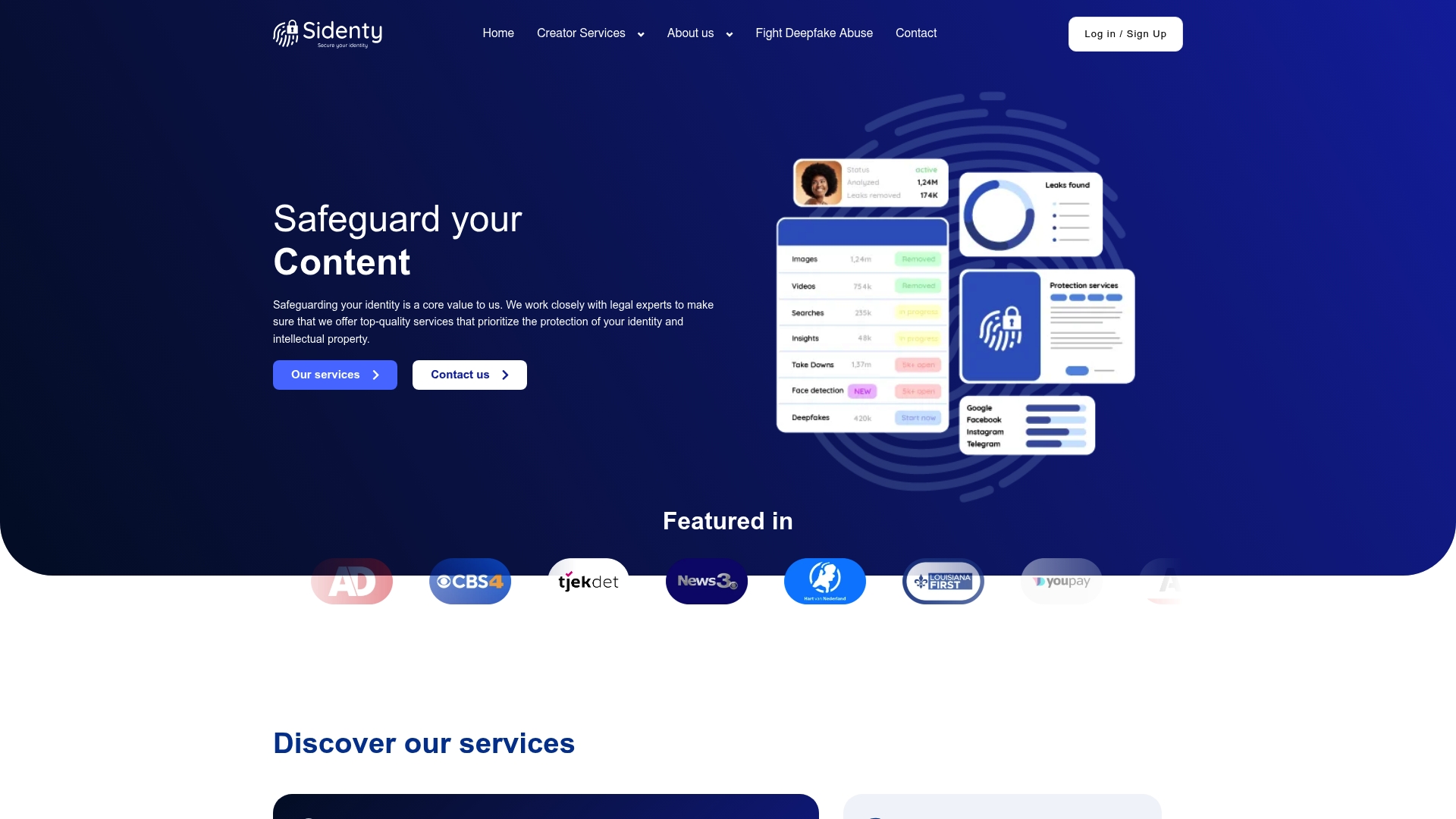
Sidenty’s 99.8% removal success rate reflects cases where connected infrastructure, not just the surface profile, was addressed. For creators dealing with synthetic media, the deepfake removal service covers detection, takedown coordination, and follow-up monitoring so the same attacker can’t rebuild the funnel. Start with a free initial assessment at sidenty.com and get a clear picture of your current exposure before the next fake account appears.
Useful resources to bookmark now
- HowToReport.org: Social Media Impersonation — Platform-first reporting guide with escalation steps for financial fraud cases.
- FTC ReportFraud.ftc.gov — File here when a follower has lost money to an impersonator operating under your name.
- IC3.gov — FBI’s Internet Crime Complaint Center; use alongside the FTC report for cases involving wire fraud or significant financial loss.
- AARP: How to Report an Impostor Account — Step-by-step reporting instructions for Facebook, Instagram, LinkedIn, TikTok, and X.
- Sidenty: Digital Identity Protection Best Practices — Monitoring and hardening checklist for creators who want to get ahead of impersonation.
- Sidenty: Creator Protection Services — Service overview for creators needing removal, monitoring, and legal escalation.
This article is general information, not legal advice. Confirm current platform policies and applicable laws with the relevant platform’s help center or a qualified attorney for your specific situation.