
How identity protection services defend against deepfake fraud
The role of identity protection services in fighting deepfake fraud has never been more consequential. These services now deploy multi-layered forensic models, liveness detection, and adaptive authentication to catch synthetic identity attacks before they cause real damage. No single check is enough. Attackers have learned to exploit any gap in a one-signal system, which is why the most effective providers run multiple independent authenticity checks simultaneously, requiring all of them to align before clearing an identity.
Here is what that defense looks like in practice:
- Liveness detection analyzes micro-expressions and physical movement to distinguish a live person from a deepfake video
- Forensic AI models probe documents and biometrics for generative AI fingerprints, even after media compression or re-upload
- Camera injection detection identifies when a fraudster feeds a pre-recorded video into a live verification session
- Facial vector analysis compares geometric identity markers against verified reference data
- Passive behavioral monitoring runs in the background, flagging anomalies in device usage and location before authorization
- Adaptive authentication escalates verification requirements only when risk signals appear, reducing friction for legitimate users
- Verified digital credentials cryptographically bind identity attributes to tamper-proof digital wallets, blocking fabricated documents at onboarding
Understanding why each layer matters requires understanding the threat itself.
What deepfakes and synthetic identity fraud actually look like
Deepfakes are AI-generated or AI-manipulated media, including video, audio, and images, that appear authentic but are entirely fabricated or altered. Synthetic identity fraud takes this a step further: fraudsters combine real and invented personal data to create a person who does not exist, then use deepfake media to give that fictional identity a convincing face and voice.
Four attack types dominate the current threat environment. Synthetic identity fraud builds a fake person from fragments of real data. Live video deepfakes inject pre-rendered face-swap footage into real-time verification sessions. Document deepfakes alter government-issued IDs to match a fraudulent identity. Audio deepfakes clone a real person’s voice to pass voice-based authentication checks. Each type targets a different weak point in the verification chain.
What has accelerated all four is accessibility. Generative AI tools capable of producing hyper-realistic synthetic media are now available through public platforms and subscription services, dramatically lowering the barrier for malicious actors. A fraudster no longer needs technical expertise. They need a subscription and a target.
The personal and organizational consequences are serious. For individuals, a convincing deepfake can destroy a professional reputation, drain a bank account, or result in criminal charges filed under a stolen identity. For organizations, a single successful deepfake attack during onboarding can expose the entire customer base to cascading fraud.
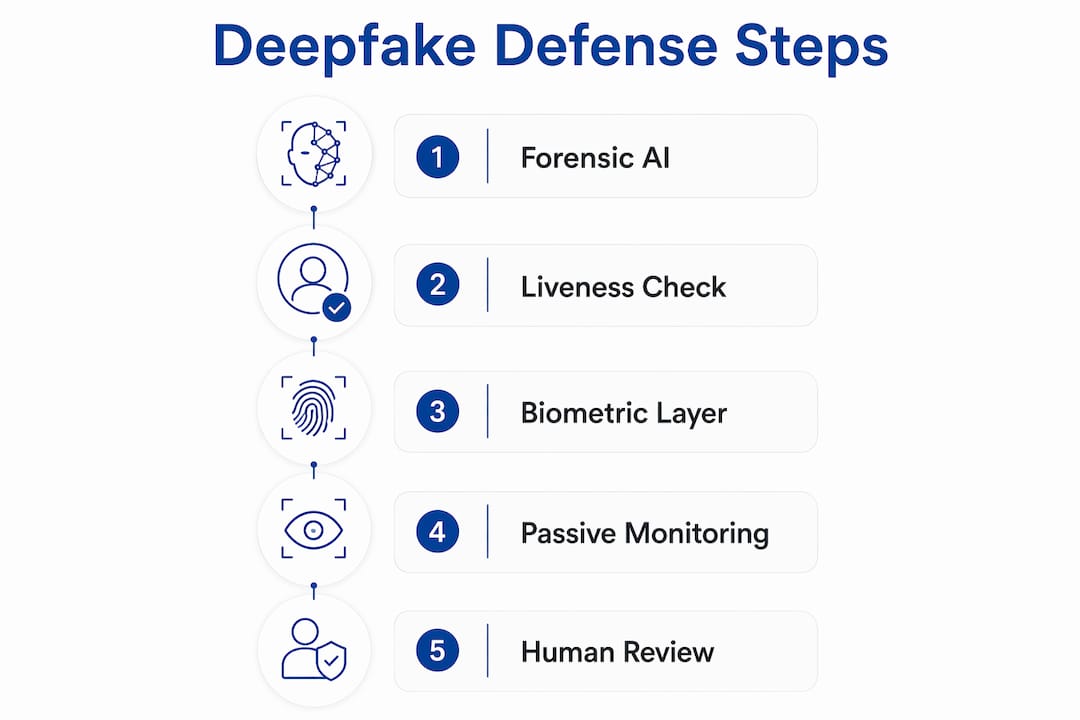
How detection actually works: the techniques identity protection uses
Detection is not a single scan. It is a coordinated sequence of checks, each designed to catch what the others might miss.
Forensic AI models
Multi-layered forensic models probe multiple independent signals for generative AI fingerprints across both documents and biometrics. One provider’s model runs seven separate checks, each examining a different authenticity signal, and all must pass before identity clearance is granted. This matters because attackers routinely compress and re-upload media to strip obvious manipulation artifacts. A model checking only one signal will miss what a second or third catches.

Liveness detection
Liveness detection analyzes micro-expressions, involuntary muscle movements, and physical responses that a deepfake video cannot replicate in real time. Financial institutions use this specifically to stop deepfake video injection attacks during remote government ID checks and onboarding sessions. The technology has already prevented fraudulent loan approvals where a deepfake video was submitted in place of a live applicant.

Layered biometric checks
The full detection stack combines:
- Liveness verification to confirm a live human is present
- Camera feed injection detection to identify pre-recorded video being fed into a live session
- Facial vector analysis to match geometric identity markers against verified reference data
- Document authenticity checks to detect AI-altered government IDs
All checks must align before a digital identity is verified. A single failure flags the session for human review. This approach eliminates the single-modality weakness that attackers have historically exploited.
Passive threat detection
Passive detection systems operate in the background, continuously analyzing behavioral signals like device usage patterns, location consistency, and session timing. When anomalies appear, the system flags the activity and can trigger additional authentication steps without interrupting a legitimate user’s session. This complements active checks by catching threats that emerge after initial login, not just at the point of entry.
Pro Tip: If you manage identity verification for an organization, ask your provider whether their passive detection runs continuously post-login or only at the authentication step. Post-login monitoring catches session hijacking that point-of-entry checks will miss entirely.
Best practices for preventing deepfake-enabled identity fraud
Prevention requires moving past the assumption that a password or a standard one-time code is enough. Regulatory bodies now prioritize phishing-resistant authentication for financial institutions specifically because legacy multifactor authentication is inadequate against AI-driven identity attacks. The shift is toward adaptive, risk-based systems that escalate verification only when something looks wrong.
Effective prevention combines several layers:
- Phishing-resistant authentication using hardware security keys or passkeys, which cannot be intercepted by AI-generated phishing attacks
- Verified digital credentials that cryptographically bind identity attributes to tamper-proof digital wallets, so fabricated documents cannot pass onboarding
- Policy-Based Access Controls (PBAC) that dynamically adjust resource access based on real-time contextual signals like role, location, and device, adding a layer of protection even if initial authentication is bypassed
- Continuous risk-based monitoring that flags anomalies in behavior patterns rather than waiting for a breach to become obvious
- Consumer and employee education on recognizing deepfake-enabled phishing, voice cloning calls, and synthetic identity requests
The education piece is often underestimated. A technically sound system can still be defeated if a human in the loop is manipulated into overriding a flag. Training people to pause and verify through a secondary channel when something feels off is a genuine countermeasure, not just a compliance checkbox.
For creators and individuals, digital hygiene practices like limiting the public availability of high-resolution photos and videos reduce the raw material available to deepfake generators. Attackers need training data. Reducing what they can access makes the attack harder to execute convincingly.
Why the legal system struggles to keep up with deepfake fraud
The law is catching up, but it has not caught up yet. The core problem is structural: deepfake creation and distribution involves fragmented actors, from the developers who build the AI models, to the platforms that host the tools, to the individuals who generate and distribute the content. Assigning liability across that chain under existing legal doctrine is genuinely difficult.
“Current legal doctrines struggle to assign liability due to multiple actors from model developers to hosting platforms. New frameworks are needed that bridge private law with identity data systems to address the evidentiary asymmetry deepfake fraud creates.” — Frontiers in Artificial Intelligence, 2026
The DMCA is the tool most commonly used to request takedowns of nonconsensual deepfake content. It works by asserting copyright over the source photos or videos used to train or generate the deepfake. The problem is that DMCA is a stopgap, not a solution. The process is manual, slow, and requires the victim to identify and report each instance individually. AI-driven replication can generate and distribute new versions faster than any notice-and-takedown process can respond. To understand the limits of DMCA protection in this context, it helps to know that the law was designed for copyright infringement, not for the mass synthetic replication of a person’s identity.
The Take It Down Act (TIDA) represents the first federal effort to impose a universal notice-and-takedown obligation specifically for nonconsensual intimate imagery, including AI-generated content. Platforms must remove flagged content within 48 hours of a valid notice. But as legal scholars have noted, the statute focuses on where harmful content ends up rather than where it comes from, leaving the platforms and tools that generate it largely untouched.
Internationally, the EU AI Act requires deployers of AI systems generating synthetic media to disclose that content has been artificially generated. China has adopted specific regulations governing deep synthesis services. A significant majority of states—specifically, over two-thirds—responding to a Council of Europe discussion paper supported addressing deepfake fraud and impersonation in a potential international instrument. The gap between these regulatory frameworks and the speed of the technology remains wide, and coordinated international enforcement mechanisms are still underdeveloped.
How industries are adapting and what the case studies show
Financial services have moved fastest. The sector faces direct, quantifiable losses from deepfake fraud during onboarding and transaction authorization, which creates a clear business case for investment in detection technology.
| Sector | Primary deepfake threat | Adaptive countermeasure |
|---|---|---|
| Financial services | Deepfake video during remote ID verification | Liveness detection, verified credentials |
| Government agencies | Synthetic identity in benefits and credential issuance | Multi-factor forensic checks, PBAC |
| Healthcare | Voice cloning for prescription fraud | Audio deepfake detection, behavioral monitoring |
| Content platforms | Face-swap impersonation of creators | Forensic AI fingerprinting, DMCA-backed removal |
| Corporate HR | Executive impersonation via audio/video | Phishing-resistant authentication, secondary verification |
The most documented case type in financial services involves deepfake video submitted during a remote government ID check. Liveness detection stopped a fraudulent loan approval in exactly this scenario, catching the injected video before the application was processed. The detection worked because the liveness check flagged the absence of involuntary micro-movements that a live applicant would produce naturally.
Government agencies face a different version of the same problem. The U.S. federal Identity Fraud Detection Playbook, maintained by IDManagement.gov, now explicitly includes deepfake detection as a required component of agency fraud prevention programs, recommending real-time video authentication tools and continuous monitoring as part of the immediate response framework.
Future trends point toward decentralized identity systems, where cryptographically verified credentials eliminate the need to share raw personal data during verification. Watermarking of AI-generated content, where a digital signature is embedded at the point of generation, is also gaining traction as a way to trace synthetic media back to its source. The role of watermarking against deepfakes is still evolving, but several AI developers have committed to embedding provenance data in generated outputs as a transparency measure. Login security is also tightening at the device level, with privacy filters on login screens becoming a recommended baseline for organizations handling sensitive identity data.
How Sidenty delivers personalized deepfake protection and removal
Sidenty’s approach to identity protection goes beyond detection. The service combines a proprietary forensic stack with active legal intervention and ongoing monitoring, built specifically for clients who have already been targeted or want to prevent targeting before it happens.
The forensic stack runs seven independent authenticity checks before clearing any identity, with no third-party models involved. Every component is proprietary, which means the detection logic cannot be reverse-engineered by studying publicly available tools. This matters because sophisticated attackers actively probe commercial detection systems to find exploitable gaps.
Sidenty’s track record speaks directly to effectiveness:
- A very high success rate in deepfake content removal for clients across platforms
- Identification of the operator behind MrDeepFakes, one of the largest deepfake repositories, through a combination of digital forensics and legal investigation
- Personalized client support with dedicated case managers who monitor for new instances of a client’s likeness appearing in synthetic content
- Combined legal and technical response, including DMCA notices, hosting provider complaints, and Google delisting requests filed in parallel
Pro Tip: If you suspect your likeness has already been used in a deepfake, document every instance you can find before requesting removal. Screenshots with timestamps and URLs create the evidentiary record that makes legal action viable and speeds up platform compliance.
The reputational damage from a deepfake is not theoretical. When synthetic content circulates under your name or face, the harm compounds with every share. Sidenty’s monitoring service catches new instances early, before they reach the scale where recovery becomes significantly harder.
How identity protection integrates with your broader cybersecurity stack
Identity protection does not operate in isolation. Its effectiveness multiplies when it connects directly with the other security systems an organization already runs.
The most productive integrations link identity verification platforms with Security Information and Event Management (SIEM) systems, so that a flagged deepfake attempt during onboarding automatically generates a security alert in the same dashboard where network anomalies appear. This gives security teams a unified view rather than siloed signals that require manual correlation.
Identity protection also connects naturally with Identity and Access Management (IAM) platforms. When a liveness check or forensic model flags a suspicious session, the IAM system can immediately restrict access, trigger step-up authentication, or freeze the account pending human review. Policy-Based Access Controls work within this integration by pulling real-time contextual data from the IAM layer to make dynamic access decisions.
For organizations using zero-trust architecture, identity verification becomes a continuous process rather than a one-time gate. Every request for a resource is treated as potentially coming from an unverified source, which means deepfake detection runs not just at login but throughout the session. Understanding online identity verification as a continuous process rather than a single checkpoint is the mindset shift that zero-trust demands.
AI systems themselves introduce a related concern. When organizations use AI tools that process user data, questions about how that data is handled become part of the identity risk picture. Understanding how AI platforms handle your data is a legitimate part of any organization’s identity protection assessment, particularly when those platforms interact with verified credentials or personal biometric data.
The practical takeaway: identity protection services are most effective when they share signals with, and receive signals from, the rest of your security infrastructure. A detection event that stays inside the identity platform and never reaches your SIEM or IAM system is a missed opportunity to stop a broader attack.
Key Takeaways
Identity protection services defend against deepfake fraud by running multiple independent forensic checks simultaneously, because no single detection signal is reliable enough on its own.
| Point | Details |
|---|---|
| Multi-layer detection is required | Liveness detection, injection detection, and facial vector analysis must all align before identity clearance is granted. |
| Legal tools have real limits | DMCA takedowns are slow and manual; the Take It Down Act addresses distribution but not the generation of synthetic content. |
| Adaptive authentication reduces risk | Phishing-resistant and risk-based authentication replaces legacy passwords and standard MFA against AI-driven attacks. |
| Sidenty achieves a 99.8% success rate in deepfake content removal, using a proprietary seven-check forensic stack and legal expertise to deliver verified results for targeted clients. | |
| Integration amplifies protection | Connecting identity verification with SIEM and IAM systems turns isolated detection events into coordinated security responses. |
Deepfake fraud is not a future problem. It is happening now, and the gap between what attackers can generate and what most organizations can detect is narrowing every month. Sidenty’s deepfake removal service combines proprietary forensic detection, active legal intervention, and continuous monitoring to give you real protection, not just a policy. If you want to understand where your identity defenses stand today, Sidenty’s digital identity protection guide for 2026 is the place to start.