
What are the top alternatives to leakedremoval.com for personal data removal?
The best personal data removal services available to US consumers right now are Incogni, DeleteMe, Optery, Privacy Bee, and Sidenty. Each takes a different approach to clearing your information from data brokers, people-search sites, and public records databases. The right pick depends on how hands-off you want to be, how many brokers you need covered, and whether your privacy concern goes beyond standard broker opt-outs into territory like leaked content or deepfake removal.
Here is a quick-reference comparison to orient you before the deeper profiles below:
| Service | Pricing Model | Best For | Effectiveness | Pros | Cons |
|---|---|---|---|---|---|
| Incogni | Annual subscription | Hands-off automation | High for standard brokers | Simple setup, bundled with Surfshark | Less human oversight |
| DeleteMe | Annual subscription | Thoroughness and breadth | Very high (750+ brokers) | Human-assisted, detailed reports | Premium price |
| Optery | Tiered subscription or one-time | Budget-conscious users | Moderate to high | Transparent broker list, free tier | Free tier is limited |
| Privacy Bee | Subscription | Family and household coverage | High | Covers family members, proactive alerts | Higher cost for full plan |
| Sidenty | Custom / project-based | Creators, leaked content, deepfakes | High content removal rate | Legal team, DMCA enforcement, deepfake prevention | Specialized focus, not a general broker opt-out tool |
A few things worth knowing upfront:
- No service offers permanent removal. Data brokers continuously re-list personal data scraped from public sources, so ongoing subscriptions or DIY maintenance are necessary.
- Automated services handle most brokers without your involvement; human-assisted services tackle the harder cases that automation misses.
- Sidenty’s specialty is digital identity and intellectual property protection, making it the strongest fit when your concern involves leaked content, unauthorized images, or deepfakes rather than standard broker opt-outs.
Table of Contents
- Detailed profiles of the leading personal data removal services
- How do you choose the right personal data removal service?
- Common questions about personal data removal services
- How do these services compare on broker coverage and pricing?
- What do customer reviews say about these services?
- How responsive is customer support across these services?
- What does the removal process look like for each service?
- Key Takeaways
- The reality of data removal that most guides skip over
- Sidenty protects what standard removal services cannot reach
Detailed profiles of the leading personal data removal services
Incogni
Incogni is built for people who want to set it and forget it. Once you authorize the service, it sends opt-out requests to data brokers on your behalf and monitors for re-listings automatically. It works especially well for users already subscribed to Surfshark VPN, since the bundle pricing makes it one of the more affordable automated options on the market. The dashboard is clean and shows you exactly which brokers have been contacted and which requests are still pending.
Key features:
- Fully automated opt-out submissions
- Continuous re-listing monitoring
- User-friendly dashboard with status tracking
- Bundled pricing available with Surfshark
The main limitation is that automation has a ceiling. Some brokers require manual intervention, identity verification, or jurisdiction-specific paperwork that automated systems cannot handle cleanly.
DeleteMe
DeleteMe is the most thorough option for users who want human eyes on their removal requests. The service covers 750+ data brokers, with a team that handles complex cases requiring custom manual requests for most of those brokers. You receive detailed quarterly reports showing what was found and what was removed. That level of transparency is genuinely useful, especially if you are trying to understand the scope of your exposure.
Key features:
- Human-assisted removal across 750+ brokers
- Custom manual requests for difficult brokers
- Quarterly privacy reports
- Strong track record and expert reviews
The trade-off is price. DeleteMe costs more than automated alternatives, and that premium is justified if thoroughness matters to you. If you just want the basics handled cheaply, it may be more than you need.
Optery

Optery occupies the middle ground between free DIY tools and premium subscriptions. It offers a free tier that scans a limited number of brokers and shows you your exposure before you pay anything. Paid tiers expand coverage and automate opt-outs across a broader list. The broker list is published transparently, so you know exactly what you are getting.
Key features:
- Free scan tier available
- Tiered subscription with expanding broker coverage
- Transparent, published broker list
- One-time removal options for budget-conscious users
The free tier is genuinely useful for getting a baseline picture of your exposure, but it will not do the heavy lifting on its own. Upgrading to a paid plan is necessary for meaningful automated removal.
Privacy Bee

Privacy Bee differentiates itself by covering household members under a single plan, which makes it a strong choice for families. It also sends proactive alerts when new data appears about you, rather than waiting for a scheduled scan cycle. The service is subscription-based and sits at the higher end of the pricing range, but the family coverage and alert system justify the cost for users with dependents or a larger household footprint to protect.
Key features:
- Family and household member coverage
- Proactive re-listing alerts
- Subscription-based with broad broker reach
- Strong customer support reputation
Sidenty
Sidenty operates in a different lane from the four services above. Where Incogni, DeleteMe, Optery, and Privacy Bee focus on data broker opt-outs, Sidenty specializes in leaked content removal and digital identity protection for content creators. Its team combines advanced technology with legal expertise to handle DMCA enforcement, deepfake prevention, and unauthorized content removal from platforms like OnlyFans and Twitch. The high content removal success rate reflects the depth of that legal and technical approach.
Key features:
- DMCA enforcement and copyright infringement removal
- Deepfake detection and prevention
- Personalized legal team support
- Platform-specific removal (OnlyFans, Twitch, and others)
If your concern is a leaked photo, an unauthorized video, or a deepfake circulating without your consent, Sidenty is the service built for that situation; standard broker opt-out tools are not equipped to handle it.
How do you choose the right personal data removal service?
The answer depends on three things: what kind of exposure you are dealing with, how much time you want to spend on it, and what you can afford to pay consistently.
Start by identifying your threat type. If your name, address, and phone number are showing up on people-search sites like Spokeo or WhitePages, a standard broker opt-out service handles that. If you are dealing with leaked images, unauthorized content, or deepfakes, that is a legal and technical problem that requires a specialist like Sidenty.
Decide how involved you want to be. Automated services like Incogni require almost no ongoing effort after setup. Human-assisted services like DeleteMe give you more thoroughness but cost more. Manual DIY tools like OfflistMe send opt-out requests directly from your own email to 500+ brokers for a one-time cost starting at $7, with no third-party data storage. That last option suits privacy purists who do not want to hand their information to another company, but it requires more personal effort to manage.
Understand the re-listing cycle before you commit. A one-time removal sounds appealing, but data brokers operate on constant re-listing cycles. Your information will reappear. An ongoing subscription is the pragmatic answer for most people, even if it feels like paying for something indefinitely.
Evaluate broker coverage against your risk profile. If you have a large digital footprint, a high-profile job, or public-facing accounts, you need broader coverage. DeleteMe’s 750+ broker reach or Privacy Bee’s proactive alerts make more sense than a basic automated service. If your exposure is limited, Optery’s lower-cost tiers may be enough.
Check the privacy policy of the service itself. You are handing personal information to a third party to remove your personal information from other third parties. That is worth thinking about carefully. Look for services that are explicit about what they store, how long they keep it, and whether they share it.
Ask about refund and satisfaction guarantees. Policies vary. Some services offer partial refunds if you cancel within a window; others do not. Read the terms before subscribing, especially for annual plans.
Consider your budget for the long term. Monthly or annual subscriptions add up. Factor in whether you need family coverage, how many brokers you want targeted, and whether you are willing to do some manual follow-up to reduce costs.
Pro Tip: When setting up any removal service, use a dedicated secondary email address and a VoIP phone number for opt-out requests. This prevents data brokers from linking your removal requests back to your primary contact details, which would only add your real information to more databases.
Common questions about personal data removal services
What should you realistically expect from a data removal service in 2026?
Expect ongoing removal, not a one-time fix. Permanent removal is not possible because brokers continuously scrape and re-list data from public sources. A good service reduces your exposure significantly and monitors for re-listings.
How does data removal from brokers actually work?
The service submits opt-out or deletion requests to data brokers on your behalf, either automatically or with human assistance. Some brokers comply within days; others take weeks or require follow-up. The most effective requests ask for suppression, not just deletion, because suppression prevents your data from being re-imported during the broker’s next database update cycle.
What is the difference between automated and human-assisted removal?
Automated services submit requests without your involvement and work well for standard brokers. Human-assisted services, like DeleteMe, handle complex brokers that require custom paperwork, identity verification, or jurisdiction-specific requests. Human-assisted services cost more but achieve broader, more thorough coverage.
How many data brokers do these services typically cover?
Coverage ranges widely. Entry-level automated services may cover a few hundred brokers. DeleteMe covers 750+ brokers, handling custom manual requests for many difficult cases. OfflistMe reaches 500+ brokers through direct user-sent requests.
Do these services offer refunds if you are not satisfied?
Policies differ by provider. Most subscription services offer a cancellation window, but annual plan refunds are not always guaranteed. Always read the terms before purchasing, particularly for premium-tier plans.
Is it safe to give a removal service your personal information?
Reputable services are explicit about their data handling. Look for clear privacy policies, limited data retention, and no data resale clauses. If a service’s privacy policy is vague, that is a red flag. Using a secondary email and phone number for the process adds an extra layer of protection.
How do these services compare on broker coverage and pricing?
Broker coverage and pricing are the two variables that most directly affect whether a service is worth the cost for your specific situation. Here is how the major options stack up in practice.
Incogni keeps pricing accessible, particularly for Surfshark subscribers, and covers a solid range of standard data brokers automatically. It does not publish a precise broker count as prominently as DeleteMe, but its automation handles the most commonly trafficked people-search and data aggregator sites. For most users with moderate exposure, it covers the ground that matters.
DeleteMe is the most transparent about coverage. Its 750+ broker reach with human-assisted custom requests for the hardest brokers is the widest of any mainstream service. The quarterly reports it sends are detailed enough to function as a privacy audit, which is genuinely useful if you want documentation of what was found and removed.
Optery publishes its broker list publicly, which is a meaningful trust signal. You can verify exactly which sites it targets before paying. The free scan tier gives you a real picture of your exposure, and paid tiers scale up from there. It is the most transparent option for users who want to know what they are buying before committing.
Privacy Bee stands out for its household coverage model. Most services charge per individual; Privacy Bee’s family plans cover multiple members, which changes the cost math significantly for households where more than one person needs protection. Its proactive alert system also means you hear about new listings faster than you would with a scheduled-scan model.
OfflistMe takes a different approach entirely. It is a one-time cost starting at $7 that sends opt-out requests directly from your own email to 500+ brokers, with no third-party data storage. That model appeals to users who are uncomfortable handing their information to yet another company. The catch is that you bear more responsibility for follow-up and re-listing monitoring yourself.
What do customer reviews say about these services?
Customer feedback across these services clusters around a few consistent themes: whether the service actually removes listings, how transparent the reporting is, and how responsive support is when something goes wrong.
DeleteMe consistently earns strong reviews for thoroughness and reporting quality. Users frequently cite the quarterly reports as a differentiator, noting that seeing documented proof of removal builds confidence. The most common criticism is price, particularly for users who feel the broker coverage they personally needed was narrower than the full 750+ list suggests.
Incogni reviews tend to highlight ease of use. Users appreciate the minimal setup and the clean dashboard. Negative feedback usually centers on the automated system missing brokers that required manual intervention, or on the pace of removals feeling slower than expected for certain sites.
Optery earns praise for its transparency and the free scan tier. Users who start with the free version and upgrade report feeling informed about what they were paying for, which reduces buyer’s remorse. The main complaint is that the free tier creates expectations the entry-level paid plan does not always meet immediately.
Privacy Bee reviews are positive on family coverage and alert responsiveness. Users with dependents or spouses who needed coverage alongside them find the household model significantly more cost-effective than paying for separate subscriptions elsewhere. Some reviews note that the onboarding process requires more personal information than competing services, which creates friction for privacy-conscious users.
Sidenty operates in a different review context. Its clients are typically content creators dealing with unauthorized content, leaked material, or deepfakes, not standard broker opt-outs. Reviews in that context emphasize the legal team’s responsiveness and the speed of DMCA enforcement actions. The service reports a high content removal success rate reflecting outcomes in that specialized domain.
How responsive is customer support across these services?
Support quality varies more than pricing pages suggest, and it matters most when a removal request stalls or a broker pushes back.
DeleteMe offers email support and has a reputation for responsive, knowledgeable replies. Because the service is human-assisted, the team handling your account is also the team answering support questions, which keeps responses grounded in your actual case rather than generic scripts.
Incogni support is primarily email-based. Response times are generally reasonable, but because the service is automated, support interactions tend to be more about dashboard questions or billing than about individual removal cases. Users dealing with a broker that the system could not handle automatically sometimes find the escalation path less clear.
Optery provides email support with a knowledge base for self-service. The free tier has limited support access, which is worth knowing before you rely on it for anything time-sensitive.
Privacy Bee is noted for proactive communication, including alerts and status updates that reduce the need to contact support at all. When users do reach out, reviews suggest response times are solid.
Sidenty provides personalized support through a dedicated legal and technical team. For creators dealing with a leak or a deepfake, that direct access to specialists is the most important support feature available. You are not filing a ticket into a queue; you are working with people who understand the legal and platform-specific mechanics of your situation.
What does the removal process look like for each service?
Understanding the actual steps involved helps you set realistic expectations and choose the service that fits your workflow.
Incogni: automated opt-out flow
- Create an account and authorize Incogni to act on your behalf.
- Incogni identifies which brokers hold your data.
- Automated opt-out requests go out to each broker.
- The dashboard updates as brokers confirm removal.
- Incogni monitors for re-listings and resubmits requests as needed.
Your involvement after step one is minimal. The system handles the cycle without prompting you.
DeleteMe: human-assisted removal
- Sign up and submit your personal information profile.
- DeleteMe’s team scans 750+ brokers for your data.
- Human agents submit opt-out and custom manual requests where required.
- You receive a detailed report within the first few weeks showing findings and actions taken.
- The team continues monitoring and re-submitting quarterly.
The human layer means harder brokers get handled, but the process takes longer than fully automated alternatives.
Optery: tiered self-service and automation
- Run the free scan to see your exposure across a limited broker set.
- Upgrade to a paid tier to expand coverage and enable automated opt-outs.
- Optery submits removal requests to brokers on your list.
- You receive a report showing confirmed removals and pending requests.
- Ongoing monitoring continues based on your subscription tier.
The free scan is a genuine first step, not just a marketing hook. It gives you real data before you commit.
OfflistMe: direct user-sent requests
- Pay the one-time fee and receive a set of opt-out request templates.
- Send requests directly from your own email to 500+ brokers.
- Track responses and follow up on brokers that do not comply.
- Repeat the process periodically as re-listings occur.
This approach keeps your data out of a third-party system entirely, but the ongoing maintenance falls on you.
Sidenty: legal and technical content removal
- Contact Sidenty and describe the unauthorized content or identity violation.
- Sidenty’s legal team assesses the situation and identifies the platforms involved.
- DMCA notices, hosting provider complaints, and platform-specific removal requests are filed.
- Google delisting requests are submitted where applicable.
- Sidenty monitors for re-uploads and escalates legally if platforms do not comply.
This process is built for situations that standard opt-out tools cannot touch. If a video of you is circulating without consent, or a deepfake is being distributed, steps one through five above are the path forward.
Key Takeaways
No single removal service works for every situation, but the right match between your threat type and the service’s strengths makes a measurable difference in your privacy outcomes.
| Point | Details |
|---|---|
| Ongoing removal is necessary | Data brokers continuously re-list scraped data, making subscriptions more effective than one-time removals. |
| Suppression beats deletion | Requesting suppression prevents brokers from re-importing your data during update cycles, unlike simple deletion. |
| Match service to threat type | Standard broker opt-outs suit people-search exposure; leaked content and deepfakes require a specialist like Sidenty. |
| Use secondary contact details | A dedicated email and VoIP number for opt-out requests prevents brokers from linking requests to your primary identity. |
| Sidenty for content creators | Sidenty’s high content removal success rate and legal team make it a strong option for creators facing leaked or unauthorized content. |
The reality of data removal that most guides skip over
Most articles about data removal services present the choice as a simple cost-versus-coverage calculation. Pick the service with the most brokers at the price you can afford, subscribe, and you are done. That framing is incomplete in a way that actually matters.
The deeper issue is that deletion and suppression are not the same thing. When you request deletion, many brokers remove your record from their active database but retain the underlying data. The next time their system runs an update cycle pulling from public records, your information reappears. Requesting suppression puts your record into a state where it cannot be re-added, which is a fundamentally different outcome. Most automated services do not distinguish between the two in their reporting, so you may see “removed” on your dashboard while the broker has only temporarily hidden your record.
The identity verification problem is also underreported. Some brokers require you to upload a government ID to process a removal request. That is a significant ask, and the irony of submitting sensitive identity documents to a data broker to get your data removed is not lost on anyone paying attention. The practical workaround is to send a paper opt-out letter citing CCPA §1798.105, which gives California residents the right to deletion without requiring invasive ID uploads. If you do upload an ID, redact everything except your name and the minimum required to verify identity.
The services that handle this well, whether automated or human-assisted, are the ones worth paying for. The ones that simply batch-submit deletion requests and call it done are providing a service that looks thorough on paper but degrades quickly in practice. For content creators specifically, the stakes are higher still. A data broker listing your home address is a privacy nuisance. A leaked video or a deepfake is a violation that requires legal intervention, not an opt-out form.
Sidenty protects what standard removal services cannot reach
If you have read this far, you understand that data broker opt-outs and content removal are two different problems requiring two different solutions. Incogni, DeleteMe, Optery, and Privacy Bee handle the broker side well. But if your situation involves leaked content, unauthorized images, DMCA violations, or deepfakes, those tools are not built for it.
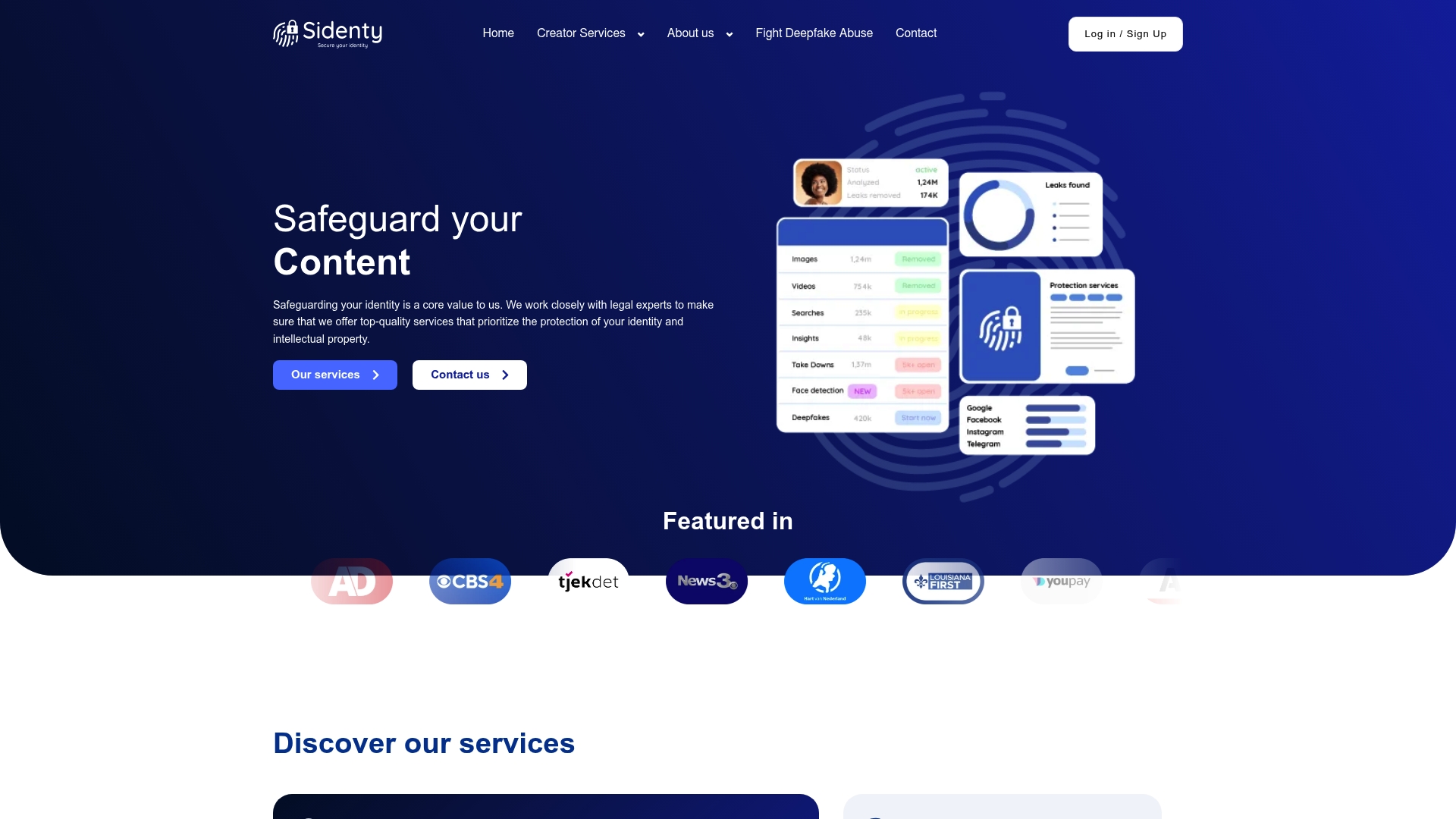
Sidenty is. With a dedicated legal team, a 99.8% content removal success rate, and platform-specific expertise across OnlyFans, Twitch, and beyond, Sidenty handles the cases that standard services cannot. You get personalized support from specialists who understand both the legal mechanisms and the technical realities of getting unauthorized content removed and kept down. For creators managing their digital identity protection alongside their public presence, that combination of legal enforcement and ongoing monitoring is what actually moves the needle.
If your privacy concern goes beyond broker opt-outs, visit Sidenty to speak with the team directly and get a clear picture of what removal looks like for your specific situation.