
- OnlyFans does not remove leaks for you. Monitoring the internet and filing takedowns is the creator’s responsibility.
- A DMCA notice is your first tool. It is a formal legal request that orders a website or search engine to remove your stolen content.
- Google delisting cuts off most traffic to a leak within 3 to 7 days, even when the original site refuses to act.
- Many piracy sites ignore DMCA notices. When that happens, hosting complaints, payment processor pressure, and legal escalation work where standard notices fail.
- Speed matters. Content caught within the first 24 hours is far easier to contain than content that has circulated for weeks.
Finding your private content posted somewhere you never agreed to is a gut punch. It feels like a violation, because it is one. There is the anger, the panic about who has seen it, and the very real worry about lost income when paying subscribers can find your work for free. On top of all that comes the worst feeling of the bunch: helplessness, the sense that the content is out there now and there is nothing you can do.
That last part is not true. You have legal rights, and you have practical tools to act on them. Learning how to remove OnlyFans leaks is a process with clear, repeatable steps, and you do not need a law degree or any technical background to follow them.
This guide is your roadmap. It walks you through finding every copy of a leak, filing takedown requests, getting leaks pulled from Google, and what to do when a site refuses to cooperate. Take it one step at a time. You have more control here than you think.
Does OnlyFans Remove Leaked Content for You?
No. This is the first thing to understand, and it surprises a lot of creators.
OnlyFans does not scan the internet for your stolen content, and it does not send takedown requests to outside websites on your behalf. The platform protects content inside its own walls, but once a video or photo leaves OnlyFans and lands on a piracy site, a Telegram channel, or a Reddit thread, the platform is not chasing it for you.
What OnlyFans does offer is real but limited. It applies watermarking with your username on content, lets subscribers report stolen material, and provides guidance through its support channels. It can also ban a subscriber caught leaking.
Everything beyond the platform itself is yours to handle. That is exactly why the steps below matter, and why knowing them puts the power back in your hands.
How Does OnlyFans Content Get Leaked?
Understanding how leaks happen helps you spot where you are exposed and reduce the risk going forward. Most leaks trace back to three sources.
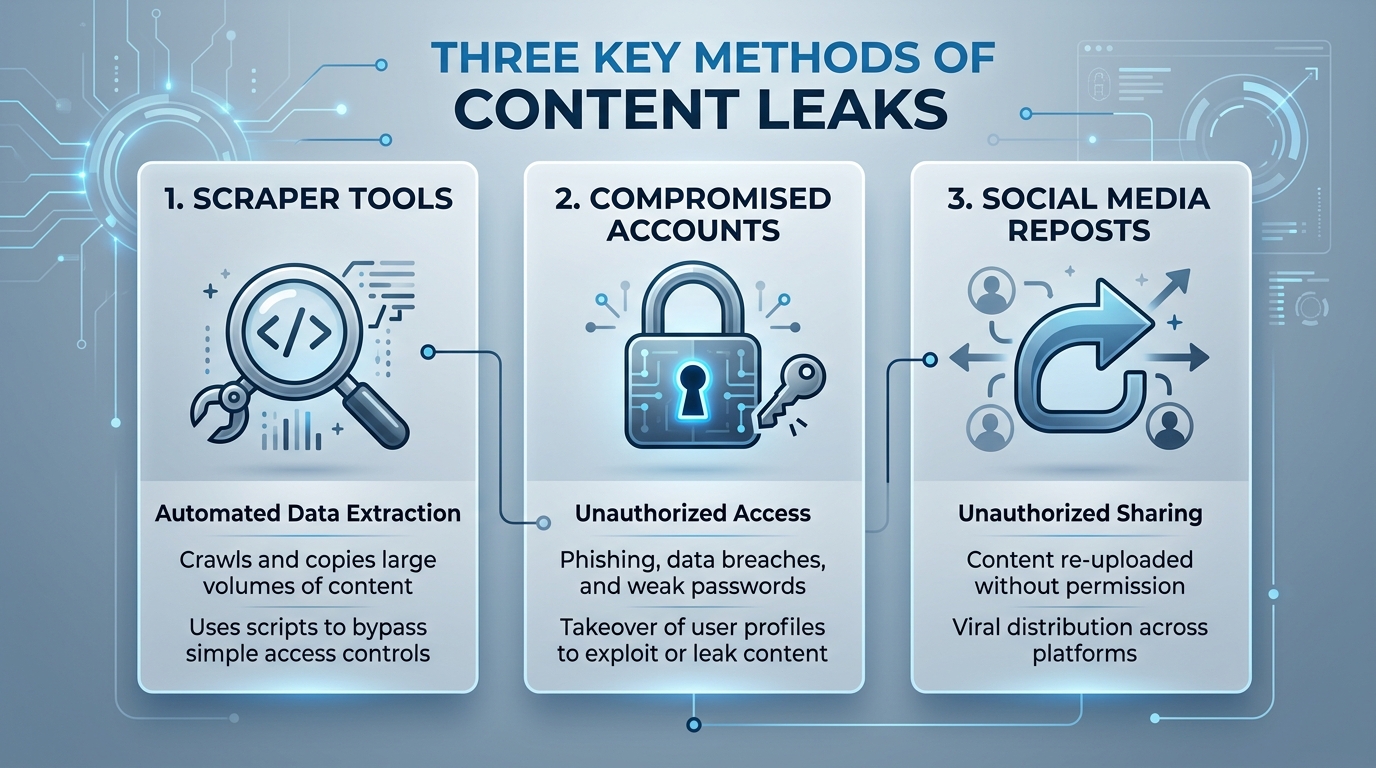
Scraper tools
Scraper tools are browser extensions and small programs built to bypass the download restrictions OnlyFans puts on content. Someone with a paid subscription installs one of these tools, and it rips an entire library of photos and videos in minutes. The subscriber paid for access to view your work, not to copy and redistribute it, but the tool ignores that line completely. A single scraper user can leak months of content in one sitting.
Compromised subscriber accounts
Sometimes the leak does not come from the subscriber at all. It comes from someone who hacked the subscriber’s account. The attacker logs into a fan’s profile and gains access to everything that fan could see, including your content. This is worth understanding clearly: the breach happens on the fan’s side, not yours. Your password was never the weak point. The result is the same, though, because your content ends up in the wrong hands.
Social media reposts
Many creators post teasers and promotional clips on Twitter, Instagram, and TikTok to attract subscribers. These public posts get downloaded, then repackaged and spread across piracy channels and forums as if they were “exclusive leaks.” The content was always meant to be public, but framing it as a stolen leak drives traffic for the pirate. This blurs the line between your marketing and an actual leak, which is why monitoring your own public clips matters too.
Step-by-Step: How to Remove Leaked OnlyFans Content
This is the core of the process. Work through these seven steps in order. Keep notes as you go, because the evidence you gather early makes every later step faster.
Step 1: Find every instance of the leak
You cannot remove what you have not found, so start with a thorough search. Search your username plus words like “leak,” “leaked,” and “free” on both Google and Bing. Run a reverse image search using Google Images, TinEye, and Yandex, since Yandex in particular surfaces results the others miss. Check the obvious places manually too: Reddit leak subreddits, Telegram channels, and the well-known piracy sites. To stay ahead of new leaks, set up a Google Alert for your username so you get notified when fresh results appear.
Step 2: Build your evidence file
For every infringing page you find, capture two things. Save the exact URL, and take a screenshot that shows both your content and the browser address bar in the same frame. Drop all of this into a tracking spreadsheet with columns for the URL, the date you found it, the takedown sent, and the status. This file is not busywork. Every DMCA notice you send relies on this evidence, and a clean spreadsheet keeps you organized when you are dealing with dozens of links at once.
Step 3: Identify who to contact
Most websites have a “DMCA,” “Copyright,” or “Report Abuse” link in the page footer. Start there. For a site that lists nothing, run a WHOIS lookup, which is a free tool that reveals who hosts the website, then prepare to contact the hosting provider instead. For social media platforms, skip the general contact forms and use their dedicated copyright reporting forms, which route your request to the right team and get faster results.
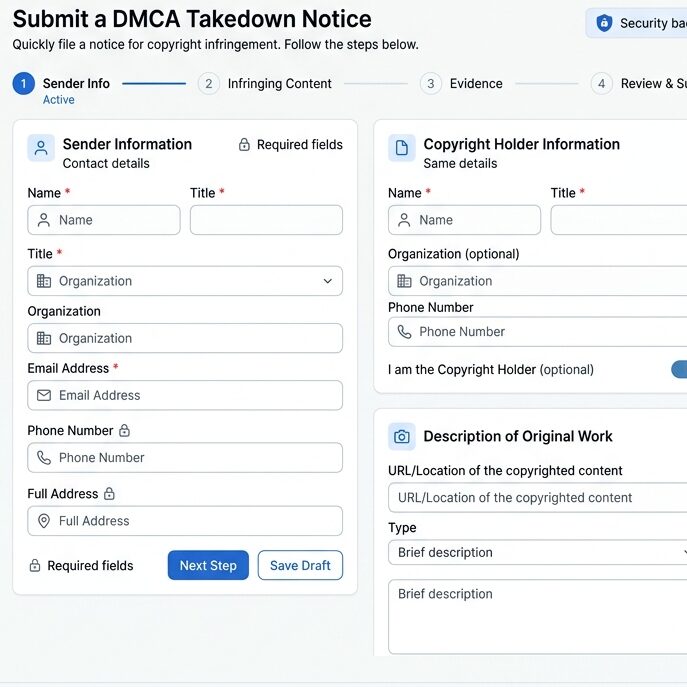
Step 4: Write and send your DMCA notice
A DMCA notice is a formal legal request, named after the Digital Millennium Copyright Act, that orders a site or search engine to take down content that infringes your copyright. A valid notice includes six things: your contact details, a link to your original content as proof you own it, the infringing URLs, a statement that you believe in good faith the use is unauthorized, a statement that the information is accurate, and your electronic signature. Many platforms give you a fill-in form that handles the structure for you. Keep your tone professional and factual. You are stating facts, not arguing.
Step 5: Follow up after one week
Sites do not always act on the first notice. If your content is still live seven days after you sent the request, send a polite follow-up that references your original notice and its date. Log every follow-up in your spreadsheet. A documented trail of contact attempts matters if you later need to escalate the case, and it shows you have given the site a fair chance to comply.
Step 6: Request Google delisting in parallel
You do not have to wait for a site to cooperate before cutting off its traffic. Use Google’s dedicated DMCA removal tool to delist the infringing URLs from search results. Once a link is delisted, people searching your name plus “leak” will not find that page, which chokes off most of the traffic even if the site itself stays online. Do the same through Bing’s content removal tool. Learning how to remove OnlyFans leaks from Google is one of the highest-impact moves available to you, because search is how most people find leaks in the first place.
Step 7: Escalate to OnlyFans support
Bring the platform back in. OnlyFans can ban the subscriber who leaked your content and, in serious cases, apply its own legal resources. Submit a report through Help & Support with all the evidence from your spreadsheet. This costs nothing, so always use it. It will not clean the wider internet for you, but it can shut down the source and stop a repeat offender.
What if you do all of this correctly and the content is still up?
What to Do When DMCA Notices Are Ignored

Here is the part most guides skip. A significant share of piracy sites simply ignore DMCA notices. They are often hosted offshore, run anonymously, or built specifically to dodge accountability. They are betting that you will get tired, give up, and move on. For many creators, that bet pays off. It does not have to be the end of your story, because there is an escalation path that works on sites that refuse to play fair.
Move through it in order.
Hosting provider complaints: Every website runs on infrastructure owned by a hosting or cloud provider, and companies like Cloudflare and AWS have abuse policies they enforce. A formal complaint to the provider can pull the site’s hosting entirely, which is a far stronger lever than emailing a site that already ignored you. You are no longer asking the pirate. You are going over their head.
Payment processor pressure: Many piracy sites make money through subscriptions, ads, or donations. Reporting the site to payment processors like Visa, Mastercard, and PayPal can cut off that revenue. Once a site stops earning, running it stops making sense, and many fold under that pressure alone.
Cease and desist letters: A cease and desist is a formal legal letter demanding that someone stop a specific activity. When it comes from a legal firm rather than your personal email, it carries real weight. It creates a documented legal record and signals that you are prepared to take this further. Most persistent violators back down at this stage.
Legal case or court filing: For repeated, profitable infringement, formal legal proceedings can lead to financial damages against the people running the site. Often the credible threat of a case is enough to get content removed without ever reaching a courtroom.
This is where the difference between tools and firms becomes important. Automated services like Rulta, Bruqi, and Enforcity are genuinely good at high-volume DMCA work on sites that follow the rules. They scan constantly and fire off takedowns at scale, and for compliant sites that is often all you need. What they cannot do is open a legal case, issue a cease and desist letter, or take a site to court. When standard notices fail, those are exactly the tools required.
That gap is where a legal firm comes in. Sidenty operates as a legal firm, not an automated tool. When a DMCA notice is ignored, Sidenty opens a formal legal case, documents every instance of infringement, and pursues removal through every legal channel available, up to and including court. The results speak to the approach: a 99.8% removal rate, more than 23,000,000 illegal copies removed, and active enforcement across 30,000+ sites. When the easy route runs out, that is the level of pressure that gets stubborn content taken down.
How Long Does Removal Take?
Timelines vary depending on where the content sits and how cooperative the site is. On mainstream platforms like Twitter/X, Reddit, and Instagram, a valid DMCA notice usually gets content removed within 24 to 72 hours. Google delisting typically lands within 3 to 7 days. Smaller sites that comply with DMCA generally act within 3 to 10 business days.
Non-compliant sites take longer because you have to go around them. Removal through a hosting complaint usually runs 1 to 3 weeks. Full legal escalation, including cease and desist letters or formal proceedings, tends to take 2 to 6 weeks.
Speed is your biggest advantage. Piracy networks mirror content aggressively, copying a single leak across dozens of sites within days. Content caught in the first 24 hours can often be contained before it spreads. Content that has circulated for weeks is much harder to pull back, because by then there are many more copies to chase. Acting fast is the single most effective thing you can do.
How to Prevent Future Leaks
Removal will always be part of the job, but good prevention means you have to do it far less often. Five habits make the biggest difference.
Watermark everything. Embed your username where it cannot easily be cropped out, such as across the center or over key parts of the frame. Watermarked content is easier to claim as yours and harder for a leaker to pass off anonymously.
Use digital fingerprinting. Digital fingerprinting embeds an invisible, subscriber-specific code into your content. If a leak appears, that code tells you exactly which subscriber account it came from, so you can take targeted action against the right person instead of guessing.
Limit free trials and heavy discounts. Creator communities report again and again that leaks come disproportionately from free trial and deep-discount accounts. Low cost and low commitment attract people who never planned to stick around, and those accounts leak at higher rates.
Be selective with PPV distribution. Keep your highest-value content for long-term, trusted subscribers through pay-per-view rather than pushing it to your entire base at once. The fewer accounts that hold your most valuable work, the smaller your exposure.
Set up ongoing monitoring. A free Google Alert for your username is a solid baseline that flags new leaks as they get indexed. Beyond that, ask your loyal fans to report leaks when they spot them. Your community often sees a leak spreading before any tool does.
Frequently Asked Questions
Can I remove leaked content if I’m no longer active on OnlyFans?
Yes. You still own the copyright to content you created, whether or not your account is still active or even still exists. Your right to file a DMCA notice and demand removal does not expire when you stop posting. The process is the same as it is for active creators.
Is the removal process confidential, and will my real name be used?
Removal can be handled discreetly. DMCA notices require a contact for the copyright holder, but that does not mean broadcasting your legal name across the internet, and a legal firm can act on your behalf to keep your personal details private. Confidential handling is standard practice, so you stay protected throughout.
What if the same content keeps reappearing after removal?
Reuploads are common, especially on piracy networks that mirror content automatically. The answer is ongoing monitoring paired with repeat takedowns, so each new copy is caught and removed as it appears. Persistent reappearance is also a strong signal that you need legal escalation rather than one-off notices.
Do automated services like Rulta and Bruqi actually work?
Yes, for what they are built to do. Tools like Rulta, Bruqi, Enforcity, and BranditScan handle high-volume DMCA takedowns on compliant sites well, and they scan constantly. Where they fall short is the sites that ignore notices, because these tools cannot open a legal case, send a cease and desist letter, or take a site to court. For those, you need a legal firm.
How long does it take to remove leaked OnlyFans content?
On mainstream platforms, valid notices usually work within 24 to 72 hours. Google delisting takes about 3 to 7 days. Compliant smaller sites take 3 to 10 business days, while non-compliant sites handled through hosting complaints or legal action can take 1 to 6 weeks. Acting fast keeps these timelines shorter.
Can leaked content be removed from Google search results?
Yes. Google has a dedicated DMCA removal tool that delists infringing URLs from search. Once a page is delisted, people searching your name will not find it, which cuts off most of the traffic even if the original site stays online. Bing offers the same kind of removal tool.
What if the person leaking my content is threatening me?
Threats change the situation, and your safety comes first. Document every message without responding to the threats, and report the behavior to the platform it is happening on and to local law enforcement. A legal firm can also factor harassment and threats into a formal case, which adds weight to the action taken against the person responsible.
What information do I need to start the removal process?
You need proof you own the content, such as a link to the original on your OnlyFans page, the URLs where the leak appears, and screenshots showing the stolen content next to the address bar. A simple tracking spreadsheet that holds all of this is enough to begin filing notices right away.
Can I remove content if I don’t know who leaked it?
Yes. You do not need to know who leaked your content to get it removed. DMCA notices target the content and the site hosting it, not the individual who uploaded it. Identifying the leaker can help with banning a subscriber or building a legal case, but it is not required to start removing copies today.
You Have More Control Than You Think
A leak feels like the end of your control, but it is not. You own your content, the law is on your side, and you now know the exact steps to get stolen copies taken down. Start by finding every copy, build your evidence, file your notices, and push for Google delisting. When sites refuse to comply, escalation works.
The one thing that matters most is moving quickly, because the sooner you act, the less ground there is to cover.
If you want to see exactly where your content has spread before you decide anything, get your free leak analysis. It shows you the full picture and a realistic removal path, with no commitment.