
A DMCA takedown notice is a formal legal request that compels Facebook to remove infringing content from its platform when properly filed. The Digital Millennium Copyright Act gives copyright holders a direct path to content removal without going to court. Filing a dmca takedown facebook request correctly means meeting six specific legal requirements and using Facebook’s official reporting system. Get it right, and your content can be removed within 24 to 48 hours. Get it wrong, and you risk delays, rejection, or even legal liability.
What are the legal and platform requirements for a DMCA takedown on Facebook?
A valid DMCA notice must include six statutory elements to be legally enforceable. Missing even one element gives Facebook grounds to reject your request without taking action.
The six required elements are:
- Identification of the copyrighted work. Describe your original work clearly. Include the title, type of content, and where it was first published.
- Identification of the infringing material. Provide the exact URL of the content on Facebook that violates your copyright.
- Your contact information. Include your full name, mailing address, phone number, and email address.
- A good faith statement. State that you believe the use is not authorized by the copyright owner, its agent, or the law.
- A penalty of perjury statement. Declare that the information in your notice is accurate and that you are the copyright owner or authorized to act on their behalf.
- Your electronic signature. Type your full legal name as your signature.
Facebook operates under DMCA safe harbor provisions, which means it is not liable for user-uploaded infringing content as long as it responds promptly to valid notices. That legal protection is Facebook’s motivation to act quickly. Using Facebook’s official form rather than an informal email is critical because the form maps directly to these statutory elements and feeds into Facebook’s compliance workflow.
Fair use is a legal defense that can protect certain uses of copyrighted material, such as commentary, parody, or education. Before you file, assess whether the content you are reporting could qualify as fair use. Filing against a legitimate fair use case can expose you to a bad faith claim.
Pro Tip: Do a quick fair use check before submitting. Ask whether the other party is commenting on, criticizing, or transforming your work. If yes, consult a copyright attorney before filing.

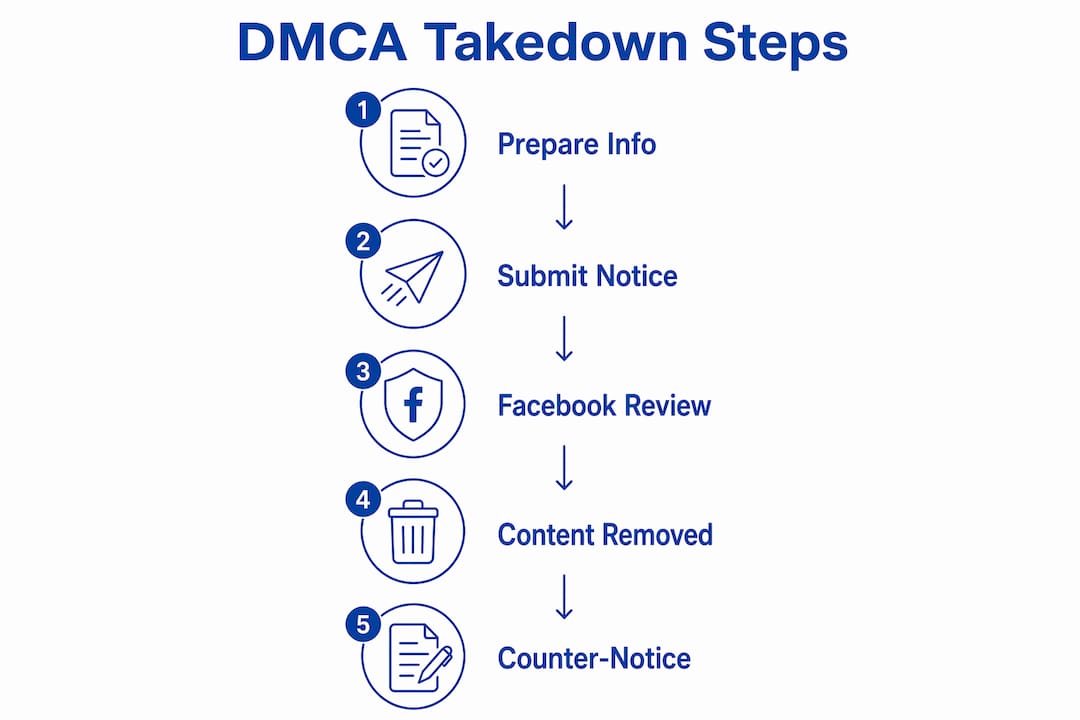
How do you prepare your information before filing a copyright removal request?
Preparation prevents the most common filing errors. Gather everything before you open Facebook’s reporting form.
- Identify your original work precisely. Note the title, creation date, and where it was first published or posted. A screenshot of your original post with a timestamp is strong evidence.
- Locate the exact infringing URL on Facebook. Open the post, video, or image in question. Copy the full URL from your browser’s address bar. A vague description like “a post on John’s page” is not sufficient.
- Confirm your ownership or authorization. If you are filing on behalf of someone else, have written authorization ready. Facebook may ask for it.
- Document the infringement with screenshots. Capture the infringing content with the URL visible. Save these files with the date in the file name for easy reference later.
- Prepare your contact details. Use a professional email address you check regularly. Facebook will send confirmation and follow-up notices to this address.
- Review your content protection legal rights. Understanding what you own and what protections apply strengthens your claim before you file.
Organized documentation does two things. It speeds up your submission and gives you a paper trail if the infringer files a counter-notice later. Treat this step as building a case file, not just filling out a form.
Step-by-step process to submit a DMCA takedown notice on Facebook
Facebook’s copyright report form is the only official channel for submitting a takedown notice. Do not send a message to the infringing user or report the content through the general “Report” button. Those routes do not trigger the DMCA process.
- Go to Facebook’s official copyright report page. Search “Facebook copyright report form” or navigate to Facebook’s Help Center and select “Report a Copyright Infringement.”
- Select the type of content being infringed. Choose from photos, videos, written content, or other media. This routes your report to the correct review team.
- Enter your contact information. Fill in your full name, email address, and country. This information becomes part of the legal record.
- Describe your original copyrighted work. Be specific. Include the title, the date it was created, and a link to the original if it is publicly accessible.
- Paste the infringing URL. This is the most critical field. An incorrect or incomplete URL will result in no action.
- Complete the legal statements. Check the boxes confirming your good faith belief and your penalty of perjury declaration. Type your full name as your electronic signature.
- Submit the form. You will receive an automated confirmation email. Save it. That email is your proof of filing.
After submission, Facebook typically processes valid notices within 24 to 48 hours. That speed reflects Facebook’s need to maintain its safe harbor status under the DMCA.
| Stage | What happens | Typical timeframe |
|---|---|---|
| Submission | Automated confirmation email sent | Immediate |
| Review | Facebook evaluates the notice for completeness | 24–48 hours |
| Action | Content removed or notice rejected | 24–48 hours |
| Notification | Alleged infringer notified of removal | Same day as removal |
| Counter-notice window | Infringer may file a counter-notice | Up to 10 business days |
Pro Tip: If you have not received a response after 7 days, send a polite follow-up referencing your original confirmation email and case number. A single, professional follow-up is reasonable and often effective.
Common mistakes when filing DMCA takedowns on Facebook and how to avoid them
Most failed takedown requests share the same preventable errors. Knowing them in advance saves you time and frustration.
- Incomplete notices. Leaving out any of the six required elements gives Facebook a reason to reject your filing without review. Double-check every field before submitting.
- Wrong or broken URLs. Copying a URL from a mobile app sometimes produces a shortened or app-specific link that Facebook’s system cannot verify. Always use a desktop browser to copy the full URL.
- Misidentifying fair use. Reporting a parody account or a news clip that comments on your work may not qualify as infringement. A rejected claim wastes your time and can damage your credibility with the platform.
- Emotional or threatening language. Objective, factual language processes faster and reduces the risk of your notice being flagged. Stick to the statutory language. Avoid phrases like “I will sue you” or “this is theft.”
- Filing false claims. Submitting a notice in bad faith can expose you to legal liability. The penalty of perjury statement is not a formality.
- No record keeping. If the infringer files a counter-notice, you will need your original documentation to respond. Keep copies of everything.
“A DMCA notice is designed to remove content quickly, not to resolve who is definitively right in a copyright dispute.” Platforms follow notice-and-takedown procedures without making legal judgments unless the case is contested.
This distinction matters. A successful takedown is not a final legal ruling. It is a temporary removal that puts the burden on the infringer to respond.
What happens after Facebook processes your DMCA takedown?
Facebook’s response follows a predictable sequence once a valid notice is received. Understanding each step helps you plan your next move.
- Content removal. Facebook removes the infringing content and sends you a confirmation. The removal is immediate upon approval of your notice.
- Infringer notification. Facebook notifies the person who posted the content that it was removed due to a copyright claim. This notification includes information about the counter-notice process.
- Counter-notice window. The alleged infringer has the right to file a counter-notice disputing your claim. If they do, Facebook may restore the content after 10 to 14 business days unless you initiate legal action.
- Repeat violation tracking. Repeated copyright violations on Facebook can lead to account restrictions or permanent suspension. Facebook tracks these under its repeat infringer policy.
- Your next steps. If a counter-notice is filed and you believe your claim is valid, consult a copyright attorney. You may need to file a lawsuit to keep the content down permanently.
The counter-notice process is the part most creators do not anticipate. Prepare for it by keeping all your original documentation organized and accessible. If you want to understand how similar processes work on other platforms, the DMCA process on X/Twitter follows a comparable structure.
What filing DMCA notices on Facebook has taught me
Filing DMCA takedowns on Facebook is not complicated, but it rewards patience and precision. The creators who struggle most are the ones who file in anger, skip the preparation steps, or expect the process to feel like justice. It is not justice. It is a legal mechanism, and it works best when you treat it like one.
The single most underrated step is the fair use check. Creators often assume that any unauthorized use of their work is infringement. That assumption leads to rejected notices and, in some cases, legal blowback. Taking five minutes to assess whether the use is transformative or commentary-based saves hours of wasted effort.
Facebook’s responsiveness is generally reliable when your notice is complete and factual. The platform has strong incentives to act quickly. When notices stall, the cause is almost always an incomplete form or an unverifiable URL, not platform negligence.
Keep a simple spreadsheet of every notice you file. Log the date, the infringing URL, your case number, and the outcome. That record becomes invaluable if you face a counter-notice or need to escalate to legal action. Organized creators win disputes. Disorganized ones lose them, even when they are right.
— Sidenty
How Sidenty supports creators with professional DMCA takedown assistance
Filing a single notice is manageable. Dealing with repeat infringers, counter-notices, and content that reappears across multiple accounts is a different challenge entirely.
Sidenty specializes in copyright infringement removal for creators across platforms including Facebook, with a 99.8% success rate in content removal. The team handles the full DMCA request process, from drafting legally sound notices to managing counter-notice responses. For creators facing persistent infringement or complex cases, professional handling reduces errors and speeds up results. Visit Sidenty’s content protection services to learn how expert support can protect your work across every platform where it appears.
FAQ
What is a DMCA takedown notice on Facebook?
A DMCA takedown notice is a formal legal request that asks Facebook to remove content that infringes your copyright. Facebook is required to act on valid notices to maintain its safe harbor protections under the Digital Millennium Copyright Act.
Is filing a DMCA takedown on Facebook free?
Filing directly through Facebook’s copyright report form costs nothing. The DMCA request process itself is free, though hiring a professional service to manage the process involves fees.
How long does Facebook take to process a DMCA notice?
Facebook typically processes valid notices within 24 to 48 hours. If you have not received a response after 7 days, send a polite follow-up referencing your original case number.
What happens if someone files a counter-notice against my claim?
Facebook will notify you of the counter-notice and may restore the content after 10 to 14 business days unless you initiate a lawsuit. Consult a copyright attorney if you receive a counter-notice on a legitimate claim.
Can I file a DMCA notice if I am not the original creator?
Yes, you can file if you are an authorized representative of the copyright owner. You must declare this authorization in your notice and may be asked to provide written proof of your authority to act on the owner’s behalf.
Key takeaways
A DMCA takedown on Facebook works when your notice is complete, factual, and submitted through the official copyright report form.
| Point | Details |
|---|---|
| Six required elements | Every valid DMCA notice must include identification, contact info, good faith statement, perjury declaration, and signature. |
| Use the official form | Submit through Facebook’s copyright report form, not through general reporting tools or direct messages. |
| 24–48 hour processing | Facebook removes valid content quickly to protect its safe harbor status under the DMCA. |
| Avoid emotional language | Objective, statutory language processes faster and reduces the risk of rejection or legal blowback. |
| Keep full records | Document every notice, URL, and case number to defend against counter-notices and repeat infringers. |