
Deepfake prevention digital hygiene is the practice of securing your online identity, accounts, and content against AI-generated synthetic media designed to impersonate or harm you. For content creators and influencers, the stakes are especially high. Deepfake impersonation fraud costs businesses nearly $500,000 per incident on average, and 49% of businesses faced video deepfake fraud in 2024. That threat has moved well beyond corporate boardrooms. Creators on OnlyFans, Twitch, YouTube, and Instagram now face the same synthetic media attacks, often with fewer resources to fight back. The good news is that a structured approach to digital hygiene puts real protection within reach.
What are the essential deepfake prevention digital hygiene practices?
Your first line of defense is controlling what attackers can access. Deepfake tools require source material, typically photos, videos, and voice recordings pulled from your public profiles. Reducing that supply directly reduces your risk.
Start with your accounts and passwords:
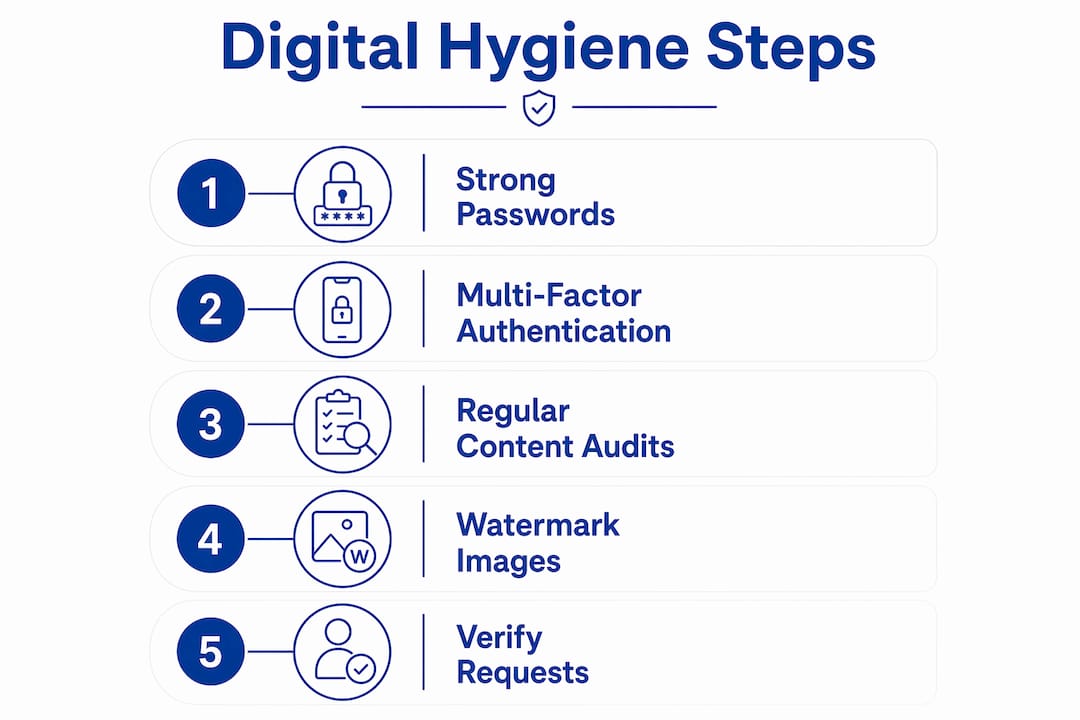
- Use passwords of at least 16 characters, stored in a password manager, with multi-factor authentication (MFA) enabled on every account.
- Never reuse passwords across platforms. A breach on one site should not cascade to your creator accounts.
- Enable app-based MFA (such as an authenticator app) rather than SMS codes, which are vulnerable to SIM-swapping attacks.
Lock down your public presence:
- Set social media profiles to private or restrict who can download your photos and videos.
- Audit your tagged content regularly. Photos posted by others can feed deepfake training data just as easily as your own uploads.
- Remove old, high-resolution images from public-facing platforms when they no longer serve a purpose.
Keep your devices and apps current:
- Install software updates promptly. Outdated apps carry known vulnerabilities that attackers exploit to harvest your data.
- Avoid clicking suspicious links in DMs, emails, or comments. Phishing remains the most common entry point for account compromise.
- Review app permissions quarterly and revoke access for tools you no longer use.
Pro Tip: Watermarking your online images deters deepfake creators by making manipulated content traceable back to its source. Free tools like Adobe Express and Canva support basic watermarking, while professional options embed invisible metadata that survives cropping and compression.
These practices form the foundation of your content creator privacy checklist. They do not require technical expertise. They require consistency.

How can you detect and verify potential deepfake content?
Recognizing a deepfake before you react to it is a skill you can build. Most synthetic media still carries telltale signs, especially in lower-budget attacks targeting individual creators rather than major public figures.
Visual and auditory cues to watch for:
- Lip-sync errors where mouth movements lag or mismatch the audio
- Unnatural blinking patterns, either too frequent or absent entirely
- Lighting inconsistencies, particularly around the hairline and neck
- Skin texture that looks overly smooth or waxy compared to the background
- Audio artifacts such as robotic tone, unnatural pauses, or background noise that cuts in and out
Verification methods that actually work:
| Verification method | What it does | Best used for |
|---|---|---|
| Out-of-band verification | Confirms identity through a separate, pre-established channel | Urgent financial or personal requests |
| Automated confidence scoring | AI tools flag media above a synthetic probability threshold | High-volume content review |
| Code words or safe phrases | Pre-agreed words confirm identity in real time | Video calls with collaborators |
| Multi-channel confirmation | Cross-checks a request across two or more platforms | Wire transfers, contract signings |
Out-of-band verification means confirming a suspicious request through a separate, pre-established channel, such as calling a known phone number rather than replying to the message you received. This single step stops the majority of deepfake-driven social engineering attacks.
Automated triage systems assign confidence scores to flagged media, blocking content above a set threshold (such as 90% synthetic probability) and routing borderline cases to human review. These tools are increasingly available to individual creators through browser extensions and platform-level integrations.
Pro Tip: Practice your detection skills using publicly available deepfake sample libraries. Several university research groups and nonprofit organizations publish labeled datasets specifically for training human reviewers. Spending 20 minutes a month reviewing examples sharpens your eye faster than any written guide.
What steps should you take if you are targeted by deepfake content?
Finding a deepfake of yourself online feels like a gut punch. The violation is real, and the urgency to act is justified. A clear sequence of steps reduces the damage and builds the legal record you may need later.
- Document everything immediately. Screenshot the content, record the URL, and note the date and time. Formal incident documentation with unique evidence IDs and a documented chain of custody is what makes your case defensible if you pursue legal action.
- Report to the platform. Most major platforms, including Meta, TikTok, and Google, have specific reporting flows for non-consensual synthetic media. Use the platform’s terms of service violation report, not just the generic “report” button.
- File with law enforcement. Submit a report to the FBI Internet Crime Complaint Center (IC3) at ic3.gov. Many states now have specific laws covering non-consensual deepfake content, and a filed report creates an official record.
- Contact a content removal service. Platforms do not always act quickly. A professional deepfake removal service can file DMCA notices, pursue Google delisting, and escalate hosting provider complaints on your behalf.
- Implement out-of-band verification going forward. After an incident, establish code words with your closest collaborators and require multi-channel confirmation for any sensitive request.
Effective forensic deepfake reports require documenting all tools, versions, settings, and alternative explanations to withstand legal scrutiny. A chain-of-custody record that tracks every step from detection to reporting is the difference between a claim and a case. Do not skip this step even if you plan to handle the removal informally.
Seeking legal counsel early is worth the cost. Laws around synthetic media are evolving fast, and an attorney familiar with digital identity law can identify remedies you would not find on your own.
Which tools and technologies support deepfake prevention and verification?
No single tool stops every deepfake threat. The most effective defense combines multiple layers, each targeting a different attack vector.
Core technology categories:
- AI detection platforms: These tools analyze media for synthetic artifacts and return a confidence score. They work best as a first filter, not a final verdict. Deepfake detection pipelines integrate automated detection, manual inspection, liveness checks, and out-of-band controls into a layered system.
- Behavioral biometrics: These systems track typing patterns, mouse movement, and interaction timing to flag accounts that behave differently from their established baseline. They catch account takeovers that password checks miss.
- Device intelligence: Camera authenticity checks and geolocation verification confirm that a video call originates from a real device in a plausible location. Layered defenses combining AI detection, device attestation, and behavioral analysis significantly reduce the success rate of synthetic media attacks.
- C2PA watermarking: The Coalition for Content Provenance and Authenticity (C2PA) standard embeds cryptographic metadata into media files at the point of creation. C2PA watermarking establishes content origin but does not guarantee the authenticity of the media itself. It is a provenance tool, not a deepfake detector.
- Virtual camera controls: Disabling virtual camera inputs in video conferencing apps prevents attackers from injecting synthetic video streams into live calls. This setting is available in most enterprise video platforms and should be enabled by default.
Deepfake threat mitigation requires combining human judgment with algorithmic detection. Neither alone is sufficient. Algorithms miss novel attack patterns; humans miss volume. The combination catches what either would miss alone.
For creators managing their online privacy risks, the practical starting point is enabling MFA, auditing public content, and choosing one AI detection tool to review flagged media. Add layers as your audience and risk profile grow.
Key Takeaways
Deepfake prevention digital hygiene works because it combines access control, behavioral verification, and rapid incident response into a system that is harder to defeat than any single measure alone.
| Point | Details |
|---|---|
| Strong authentication is non-negotiable | Use 16-character passwords with MFA on every creator account to block unauthorized access. |
| Limit your biometric exposure | Restrict public access to photos and videos to reduce the source material available for deepfake creation. |
| Verify before you trust | Use out-of-band verification and code words to confirm identity for any sensitive or urgent request. |
| Document incidents formally | Record URLs, timestamps, and evidence IDs immediately to build a defensible legal record. |
| Layer your technical defenses | Combine AI detection, behavioral biometrics, and device intelligence rather than relying on one tool. |
The verification mindset is the real protection
Working with creators and influencers who have been targeted by deepfakes, the pattern Sidenty sees most often is not a technology failure. It is a trust failure. Someone received a video that looked real, sounded real, and came from a familiar face. They acted on it before they questioned it.
The uncomfortable truth is that no detection tool catches everything. Security culture that prioritizes verification over trust helps individuals pause and verify before acting on suspicious media. That pause is the most valuable habit you can build. It costs nothing and stops attacks that $10,000 in software would miss.
Sidenty also sees creators go too far the other way, becoming so suspicious that they damage their working relationships by demanding verification for every routine interaction. The goal is calibrated skepticism, not paranoia. Reserve your verification protocols for high-stakes actions: financial transfers, contract signings, access grants, and public statements made on your behalf.
The AI threat is not static. New synthesis techniques emerge regularly, and today’s detection tools will miss tomorrow’s attacks. Continuous learning matters as much as any single tool. Set a reminder to review your digital hygiene practices every quarter, the same way you would review your account passwords. The creators who stay protected are the ones who treat this as an ongoing practice, not a one-time setup.
— Sidenty
How Sidenty protects your digital identity against deepfakes
Sidenty works with content creators, influencers, and individuals who need more than general advice. When a deepfake appears, the clock starts immediately, and platform response times rarely match the urgency.
Sidenty’s team combines legal expertise with technical execution, filing DMCA notices, pursuing Google delisting, and escalating hosting provider complaints with a 99.8% content removal success rate. For creators building their long-term protection, Sidenty’s digital identity protection best practices guide covers the full framework for 2026, from account security to incident response. Whether you are dealing with an active deepfake threat or building your defenses before one appears, Sidenty offers the personalized support that generic tools cannot match.
FAQ
What is deepfake prevention digital hygiene?
Deepfake prevention digital hygiene is the set of proactive practices, including strong authentication, biometric data restriction, and verification protocols, that reduce your risk of being impersonated or harmed by AI-generated synthetic media.
How do I know if a video of me is a deepfake?
Look for lip-sync errors, unnatural blinking, lighting inconsistencies around the hairline, and audio artifacts. Automated AI detection tools can assign a synthetic confidence score to flagged media for a more reliable assessment.
What should I do first if I find a deepfake of myself online?
Document the content immediately with screenshots, URLs, and timestamps, then report it to the platform and file a complaint with the FBI IC3. A formal evidence record is critical for any legal action that follows.
Does watermarking actually prevent deepfakes?
Watermarking deters misuse by making manipulated content traceable, but it does not make deepfake creation technically impossible. C2PA-standard watermarks establish content origin and are the most defensible option currently available.
How often should I review my digital hygiene practices?
Review your account security, public content exposure, and verification protocols at least once per quarter. Deepfake synthesis techniques evolve quickly, and practices that were sufficient six months ago may need updating.