
Online harassment via impersonation is the intentional, unauthorized use of your name, image, likeness, or identifying details to create a fake digital presence designed to harass, deceive, defraud, or damage your reputation, as defined by North Carolina Criminal Law and framed by IFTAS as a direct attack on trust. If it’s happening to you right now, your first move is to document everything and report to the platform. U.S. law on this is state-specific: Texas Penal Code Section 33.07, for example, explicitly criminalizes creating a fake profile in someone else’s name without consent and with intent to harm or defraud. Resources like WomensLaw.org and Sidenty can help you navigate what comes next.
Legal note: U.S. impersonation law is largely state-based. The threshold in most statutes is intent plus lack of consent. This article is general information, not legal advice. Confirm the rules for your situation with a qualified attorney or your state’s law enforcement agency.
Table of Contents
- What does online impersonation actually look like?
- How is impersonation different from identity theft?
- Why impersonation causes real, lasting harm
- What U.S. law says about online impersonation
- What to do right now if someone is impersonating you
- How to reduce your risk of being impersonated
- When should you get professional help?
- Trusted resources and report templates
- Key Takeaways
- Why impersonation is the threat most people underestimate
- Useful sources and further reading
What does online impersonation actually look like?
Impersonation takes more forms than most people expect. The most common tactics include:
- Fake social media profiles that copy your name, photo, and bio to contact your followers or colleagues
- Cloned accounts that mirror your posting style to deceive people who know you
- Deepfake video or audio that places your likeness in fabricated scenarios
- Spoofed emails or messages sent from an address designed to look like yours
- Fake ads or listings that use your photo to direct strangers to your address or phone number
Three scenarios show how these tactics escalate. First, a slow-burn fake profile quietly mirrors your public posts for weeks, building credibility with your contacts before the impersonator starts spreading false information in your name. Second, a fake classified ad uses your photo and real address, sending strangers to your door. Third, a deepfake video is created and sent to your employer or partner as a form of extortion.
Pro Tip: Impersonators rarely start with an obvious attack. According to Cybertrace, they often harvest publicly available photos and details over time, building a convincing fake profile long before any visible harassment begins. Run a reverse-image search on your profile photos every few months to catch this early.
How is impersonation different from identity theft?
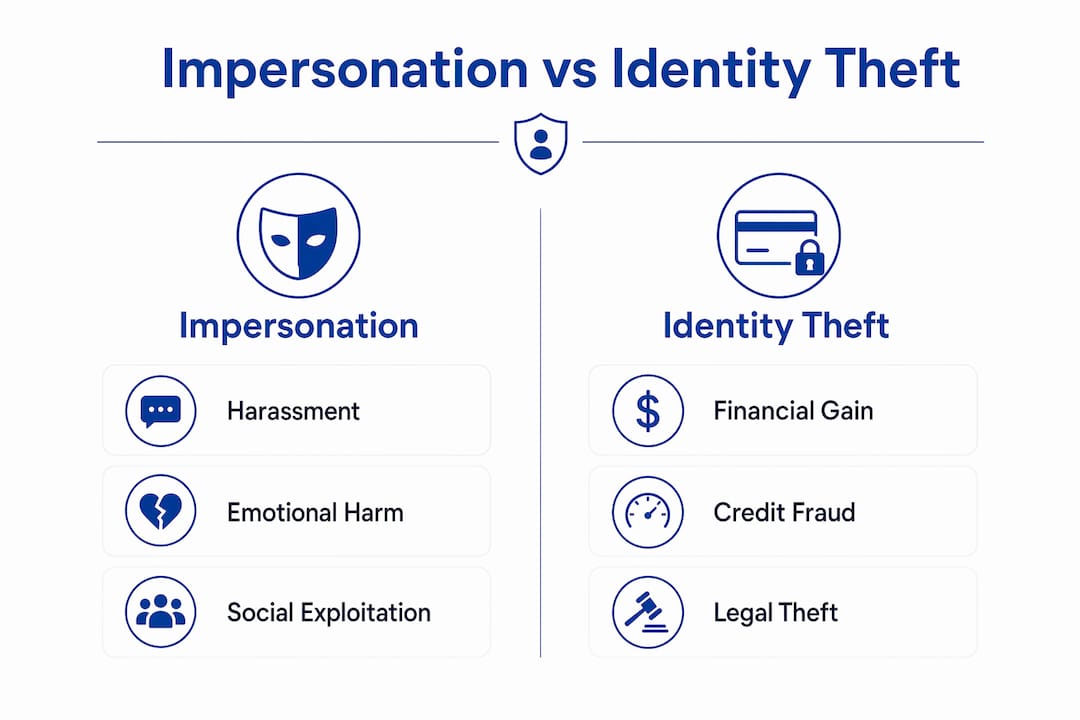
These two threats feel similar but follow different paths, and the distinction shapes which agencies and remedies apply to you.
| Dimension | Online impersonation | Identity theft |
|---|---|---|
| Primary intent | Harass, humiliate, or damage reputation | Commit financial fraud |
| Data typically used | Name, photo, bio, public posts | SSN, account credentials, financial data |
| Common outcome | Reputational harm, emotional distress, social isolation | Fraudulent loans, drained accounts, credit damage |
| Typical legal pathway | State harassment, cyberstalking, or impersonation statutes | Federal fraud statutes, FTC reporting |
As Heimdal Security explains, impersonation focuses on exploiting a persona for social or emotional harm, while digital identity theft involves stealing personal data to commit financial fraud. The line blurs when an impersonator starts soliciting money from your contacts in your name. At that point, the behavior can cross into fraud and trigger federal prosecution alongside state charges. Knowing which category your situation falls into helps you contact the right agency from the start.

Why impersonation causes real, lasting harm
IFTAS frames impersonation as a trust problem at its core: a fake account doesn’t just mislead one person, it corrodes your credibility across an entire community. The harm compounds quickly.
Reputationally, false statements made in your name can reach hundreds of contacts before you’re even aware the account exists. Emotionally, victims describe a gut-punch feeling of violation, followed by ongoing anxiety about what the impersonator might do next. Socially, friends and colleagues who interact with the fake account may pull back from the real you, unsure what to believe.
The physical risks are less discussed but just as serious. WomensLaw.org documents cases where impersonators posted fake ads directing strangers to a victim’s home address, or used a victim’s identity to solicit sexual contact from third parties. These aren’t edge cases. They’re a recognized pattern of technology-facilitated abuse that can put you in physical danger. Understanding the privacy risks creators and public figures face makes clear why early action matters so much.
What U.S. law says about online impersonation
Most legal protection against impersonation in the United States comes from state law, not federal statute. There is no single federal “online impersonation” law; instead, prosecutors typically use state harassment, cyberstalking, or fraud statutes depending on the conduct involved.
Texas Penal Code Section 33.07 is one of the clearest examples. It explicitly criminalizes creating a fake online profile in another person’s name without their consent, when the purpose is to harm, defraud, intimidate, or threaten. The statute covers social media accounts, email addresses, and other digital identities. Penalties can reach a third-degree felony depending on the harm caused.
One critical nuance: parody and satire accounts are frequently protected under both platform policies and the First Amendment, provided they are clearly labeled as parody. An account that says “Parody of [Your Name]” in the bio sits in a different legal and moderation category than one that pretends to be you without any disclaimer. When you’re seeking removal or prosecution, documenting that the account contains no parody label and was designed to deceive is one of the most important things you can do.
What to do right now if someone is impersonating you
Speed and documentation quality determine how this goes. Follow these steps in order.
- Screenshot everything immediately. Capture the fake profile, posts, messages, and any interactions. Screenshots alone can be challenged, so also save the full URL of each page.
- Archive the pages. Use a tool like the Wayback Machine or a PDF export to preserve the content with metadata intact. Automated platform reports succeed at a higher rate when you provide a curated evidence dossier with timestamps and full URLs rather than screenshots alone.
- Collect dates and context. Note when you first discovered the account, what harm it has caused, and which platform terms of service it violates.
- Report to the platform. Use the platform’s dedicated impersonation report form. Be specific: name the policy clause violated, attach your evidence, and state clearly that you did not consent to the account’s creation.
- Warn your contacts. A brief message to close friends and colleagues prevents the impersonator from manipulating people who trust you.
- Change passwords and enable 2FA on any accounts that share a username or email with the fake profile.
- Contact law enforcement if the impersonation involves threats, fraud, or physical danger. Bring your evidence dossier and a written statement of facts.
Pro Tip: Never rely on a screenshot alone as your sole evidence. Platforms and law enforcement need to verify that the content existed and when. Save full-page web archives or PDF exports with embedded timestamps. If the page disappears before you archive it, the Wayback Machine’s “Save Page Now” feature can sometimes recover a cached version.
How to reduce your risk of being impersonated
Prevention starts with shrinking the surface area an impersonator can exploit.
Tighten your privacy settings on every platform. Set photos, friend lists, and location data to “friends only” or equivalent. Audit what a stranger can see on your profile right now, because that’s exactly what an impersonator sees too.
Audit your public photos and metadata. Images posted publicly can be downloaded and reused. Strip metadata from photos before posting, and audit your digital footprint regularly to see what’s already out there.
Use verified accounts where available. Platform verification makes it harder for impersonators to pass off a fake account as the real you. When choosing between platform verification and third-party services, platform-native verification carries more weight with moderation teams. Avoid sharing your verification email address publicly, since it becomes a target.
Enable strong, unique passwords and 2FA on every account. A cloned account is far more convincing when the impersonator can also lock you out of your own profile.
Monitor your name and images. Set up Google Alerts for your name and common username variants. Run periodic reverse-image searches using Google Images or TinEye. For creators, brand-monitoring tools can flag unauthorized uses of your photos across platforms before they escalate.
Pro Tip: Limit sharing of location and daily routine details. Impersonators use routine information to make fake profiles feel authentic. The AI consent layer concept emerging in 2026 policy discussions highlights how even small data points, when aggregated, can be used to build convincing synthetic identities.
When should you get professional help?
Platform reporting works for straightforward cases. When it doesn’t, professional services fill the gap.
Takedown and DMCA routes apply when the impersonator uses your original photos or video. Filing a DMCA notice alongside an impersonation report often speeds removal because it adds an intellectual property violation to the moderation queue. UCLA’s CISO office recommends evaluating both policy and IP routes simultaneously.
Deepfake removal requires specialized tools and legal leverage that most individuals don’t have on their own. Sidenty’s deepfake removal service combines technical takedown with legal escalation, and the team reports a 99.8% success rate in content removal across platforms.
Legal cease-and-desist and litigation support become necessary when the impersonator is identified and continues despite platform removal. An attorney can send a formal demand and, if needed, pursue civil remedies.
Ongoing monitoring matters after a takedown because impersonators often recreate accounts. Sidenty’s services include continuous monitoring for creators and public figures, covering platforms like OnlyFans and Twitch where identity protection for creators is a recurring need.
Consider paid help when: threats are severe or repeated, financial fraud is involved, deepfakes are in wide circulation, or platform reporting has already failed. Those four conditions are the clearest signals that DIY steps have reached their limit.
Sidenty offers professional takedown, deepfake removal, and ongoing monitoring for individuals and creators. Explore digital identity protection best practices or contact the team directly when the risk is too high to handle alone.
Trusted resources and report templates
Key organizations:
- IFTAS: Guidance on platform moderation expectations and impersonation definitions used by trust and safety professionals.
- WomensLaw.org: Practical abuse resources, including technology-facilitated harassment and impersonation.
- State statute lookup: Search “[your state] online impersonation law” or consult your state attorney general’s website for the applicable statute.
- Platform safety pages: Each major platform (Meta, X, TikTok, LinkedIn) maintains a dedicated impersonation report form linked from its Help Center.
Platform report template:
Police report template:
When evaluating a professional service, ask about: average takedown speed, whether legal support is included, documented success metrics, and how the service handles your personal data. A service that cannot answer all four questions clearly is not ready to handle your case.
Key Takeaways
Online harassment via impersonation causes reputational, emotional, and physical harm, and your best defense is fast documentation combined with platform reporting and, when needed, professional escalation.
| Point | Details |
|---|---|
| Core definition | Impersonation is unauthorized use of your identity with intent to harm, deceive, or defraud. |
| First action | Document evidence with full URLs and archived pages, then report to the platform immediately. |
| Impersonation vs. identity theft | Impersonation targets reputation and social harm; identity theft targets financial fraud. |
| Legal reality | U.S. law is state-specific; Texas Penal Code §33.07 is one concrete example of a dedicated statute. |
| Top prevention step | Tighten privacy settings, audit public photos, and monitor your name with Google Alerts. |
| When to escalate | Seek professional help when threats are severe, deepfakes are involved, or platform reporting has failed. |
Why impersonation is the threat most people underestimate
Most people assume impersonation is something that happens to celebrities. It isn’t. The cases Sidenty encounters most often involve creators, small-business owners, and private individuals whose public-facing presence, even a modest one, gave an adversary enough material to work with. What makes impersonation uniquely damaging is that it weaponizes your own credibility against you. The fake account doesn’t need to fool everyone. It only needs to fool the people who matter: your employer, your clients, your family. By the time most victims realize what’s happening, the impersonator has already had days or weeks of unchallenged access to those relationships. The slow-burn approach documented by Cybertrace isn’t a rare tactic. It’s the default. That’s why the prevention steps in this article aren’t optional extras. They’re the difference between catching a fake profile at week one and discovering it at month three.
Useful sources and further reading
- Online Impersonation, North Carolina Criminal Law Blog: Core legal definition of online impersonation in U.S. context; useful for understanding the intent threshold.
- IFTAS Library: Impersonation: Trust and safety professional guidance on moderation outcomes and platform expectations.
- WomensLaw.org: Impersonation: Advocacy-focused resource covering technology-facilitated abuse and physical danger scenarios.
- Texas Penal Code Section 33.07 (via Scheiner Law): Plain-language explanation of Texas’s dedicated online impersonation statute and its elements.
- Cybertrace: Social Media Impersonation and Harassment: Practitioner perspective on evidence dossiers and slow-burn impersonation tactics.
- UCLA CISO: Protect Against Online Harassment: Guidance on DMCA and copyright routes alongside standard impersonation reporting.
- Heimdal Security: Online Impersonation Explained: Clear comparison of impersonation versus identity theft and practical prevention hygiene.
For jurisdiction-specific questions, consult a licensed attorney in your state. Laws vary significantly, and a qualified professional can assess your exact situation.