
A creator’s digital identity is the collection of verifiable online signals, credentials, and platform attributes that prove who you are, establish trust with your audience, and protect your ability to earn. This goes far beyond a username or profile photo. Platforms increasingly require identity verification to access monetization and subscription features, especially as AI fraud rises across every major platform. Your digital identity includes verification badges, Know Your Customer (KYC) records, content history, and behavioral data. Understanding what is creator digital identity is the first step toward protecting everything you have built.
What are the core components of a creator’s digital identity?
A creator’s digital identity is not a single credential. It is a layered system of signals that platforms, sponsors, and audiences use to verify you are real, consistent, and trustworthy.
The most visible component is your verification badge, the platform-issued checkmark that signals official status on YouTube, Instagram, or Twitch. Beneath that sits your KYC record, the identity documents you submit to unlock monetization features. Platforms use these records to confirm you are a real person, not a bot or AI-generated account. Content history adds another layer. The archive of posts, videos, and interactions you have built over time creates a behavioral fingerprint that is hard to fake.

Behavioral data rounds out the picture. Platforms track posting patterns, engagement rates, and login locations to flag anomalies. A sudden shift in behavior, like logging in from a new country or posting at unusual hours, can trigger security reviews. This data protects you, but only if your identity foundation is solid.
One distinction creators often miss: digital identity differs from digital persona. Your digital identity is the operational record, the credentials, access rights, and verification signals. Your digital persona is the public-facing character your audience sees. Both matter, but they serve different functions.
| Component | Role |
|---|---|
| Verification badge | Signals official platform status to audiences and sponsors |
| KYC records | Confirms real human identity for monetization access |
| Content history | Creates a behavioral fingerprint that proves authenticity over time |
| Behavioral data | Flags anomalies and protects against account takeover |
| Portable trust signals | Maintains proof of identity across platforms beyond a single profile |
How can creators protect their digital identity against impersonation and AI threats?
Impersonation is no longer just someone copying your username. AI-generated deepfakes can now replicate your voice, face, and content style with alarming accuracy. The threat is real, and the response needs to be deliberate.
Biometric-backed identity verification services generate timestamped public verification pages that prove real human presence. These pages uphold your Name, Image, and Likeness rights and give you documented proof to act against unauthorized AI use of your likeness. Think of it as a notarized certificate for your online existence.
Protecting your accounts requires more than a strong password. Here are the security practices that actually work:
- Enable multi-factor authentication (MFA) on every platform, not just the ones you consider important. Use an authenticator app rather than SMS, since phone numbers can be hijacked through SIM swapping.
- Use hardware security keys like a YubiKey for your most critical accounts. These physical devices make remote account takeover nearly impossible.
- Set up portable trust signals by linking a centralized, verifiable bio page in all your profiles. Platform-specific verification does not protect you beyond that platform, so a portable signal ensures your authenticity travels with you.
- Apply risk-based authentication inspired by financial industry practices. This means adding extra verification steps when logins come from new devices or locations.
- Use delegated access with granular permissions instead of sharing passwords with managers or editors. Granting managers account access without permission controls is one of the most common causes of security incidents for creators.
- Monitor for content theft regularly using dedicated tools. Catching unauthorized use of your content early limits the damage.
Pro Tip: Schedule a quarterly security audit. Check which apps have access to your accounts, revoke anything you no longer use, and update your recovery contact information. Document your recovery plan in a secure location so you can act fast if something goes wrong.
What is the difference between a digital identity and a digital persona for creators?
The confusion between these two concepts causes real problems. Creators who conflate them either over-expose their private credentials or under-protect their public brand.
Digital identity functions as the control plane for authorization and policy enforcement. It governs who can access your accounts, what permissions they hold, and how your credentials are managed over time. This is the private, operational layer. It includes your login credentials, two-factor authentication settings, recovery emails, and any linked payment or legal documents.
A digital persona is the public-facing expression of your brand. It is the character, voice, and visual identity your audience recognizes. VTubers are a clear example: the animated avatar is the persona, but the real person behind it holds a distinct digital identity with its own credentials and legal rights. Pseudonymous creators and those who run branded channels separate from their legal name follow the same model.
Keeping these layers separate protects you in two ways. First, it limits exposure. If your persona is compromised, your core identity credentials remain intact. Second, it gives you control over your reputation. You can retire or rebrand a persona without losing your verified identity history.
Here is how to create and manage both effectively:
- Define your persona parameters. Decide what name, avatar, and voice your public brand uses. Document these assets in a brand guide.
- Create a separate email address for each persona that does not connect to your personal identity.
- Register your persona’s username across all major platforms, even ones you do not currently use. This prevents squatting.
- Link your persona to your verified identity through a private legal record or notarized document, so you can prove ownership if disputed.
- Audit persona access quarterly. Confirm who can post, edit, or manage the persona’s accounts, and revoke access that is no longer needed.
Digital personas are brand assets that require the same governance discipline as your core identity. Neglecting either layer creates gaps that bad actors exploit.
How to build and maintain a resilient creator identity stack
Static login credentials are not a digital identity. A documented identity stack encompasses identifiers, discovery protocols, and verification signals that need continuous auditing to stay secure. Building this stack is a one-time investment that pays off every time a threat appears.
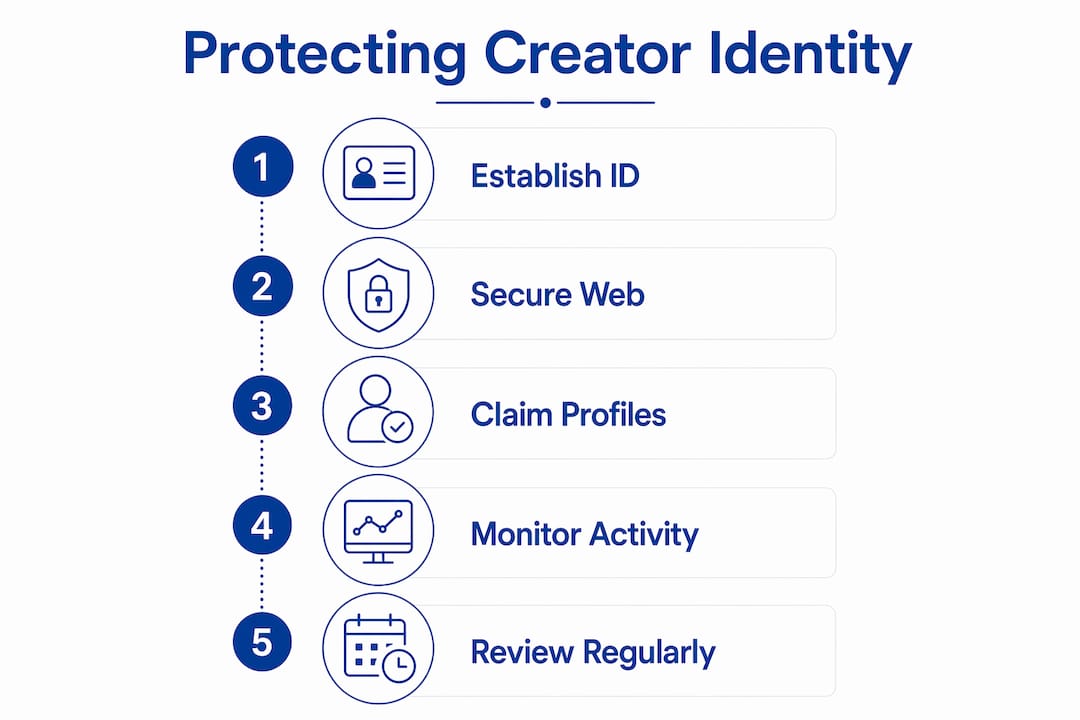
Identity foundation
Start with your naming assets: your legal name, your creator name, and any personas. Document your bio copy, avatar files, and brand colors in a single folder you control. These assets are the raw material of your public presence. Losing them to an impersonator is like losing your business license.
Domain and web presence
Own a domain that matches your creator name. A personal website or landing page gives you a proof layer that no platform can take away. If a platform bans or suspends your account, your domain remains. Link your verification pages and social profiles from this domain to create a web of trust that is hard to replicate.
Profile coverage and monitoring
Claim your username on every major platform, even ones you do not actively use. Unclaimed usernames are open invitations for impersonators. Use a content theft monitoring service to track unauthorized use of your name, likeness, or content across the web.
Security and recovery
Document your recovery plan. Write down the steps to regain access to each account if you are locked out. Store this document in an encrypted password manager or a physical safe. Test the recovery process annually so you know it works before you need it.
Pro Tip: Schedule a quarterly identity review. Update your portable trust signals, check that your recovery contacts are current, and confirm that delegated access permissions still match your team structure. Thirty minutes every three months prevents months of damage control.
| Identity stack layer | Function | Review frequency |
|---|---|---|
| Naming and brand assets | Establishes recognizable, ownable creator identity | Annually or after rebrand |
| Domain and web presence | Provides platform-independent proof of identity | Annually |
| Username coverage | Blocks impersonation on unused platforms | When joining new platforms |
| Verification signals | Builds portable, cross-platform audience trust | Quarterly |
| Security and recovery | Protects access and enables fast incident response | Quarterly |
Building digital trust signals into your public presence is not optional at this stage of the creator economy. Audiences and sponsors both look for proof that you are who you claim to be.
Key Takeaways
A creator’s digital identity is a layered, verifiable system of credentials, signals, and behavioral data that protects both your authenticity and your income.
| Point | Details |
|---|---|
| Identity is more than a login | Your digital identity includes KYC records, behavioral data, and verification badges, not just a password. |
| Separate identity from persona | Keep your operational credentials private and your public persona documented as a distinct brand asset. |
| Portable trust signals matter | Platform verification alone does not protect you; link a centralized verification page across all profiles. |
| Delegated access needs controls | Never share passwords; use permission-based access for managers and editors to prevent account takeover. |
| Audit quarterly | Regular reviews of access, recovery plans, and verification signals prevent security drift before it causes damage. |
Sidenty’s take on managing creator digital identity in 2026
Most creators treat their digital identity as a login problem. It is not. It is a governance problem, and the gap between those two framings is where most incidents happen.
At Sidenty, we work with creators who have had accounts cloned, deepfakes published, and content stolen at scale. The pattern is almost always the same: the creator had strong content but a fragile identity infrastructure. No portable verification. No documented recovery plan. Passwords shared with three people who no longer work with them.
The financial services industry solved this problem decades ago with risk-based authentication, permission delegation, and lifecycle management. Creators need to borrow that discipline. Your identity is a business asset with real monetary value. Treat it like one.
The AI threat is not theoretical. Deepfake technology now produces convincing video and audio from a handful of source clips. Proof-of-human verification, the kind that generates a timestamped, publicly accessible record, is becoming a baseline requirement for serious creators. Sponsors and platforms will increasingly demand it.
The creators who build resilient identity stacks now will have a measurable competitive advantage. They will close sponsorship deals faster, recover from incidents quicker, and spend less time fighting fires. The ones who wait will find out the hard way that rebuilding trust after an impersonation incident takes far longer than building it in the first place.
You can also review the privacy risks influencers face to understand the full threat picture before you build your identity stack.
— Sidenty
How Sidenty protects your creator digital identity
Your identity is your most valuable asset as a creator. Losing control of it means losing your audience, your income, and your reputation.
Sidenty specializes in protecting creator digital identities with a 99.8% success rate in content removal. The team handles copyright infringement takedowns, deepfake removal, and unauthorized content removal across platforms including OnlyFans and Twitch. Every case gets a dedicated legal expert and a personalized protection plan. If your content has been stolen, your likeness misused, or your identity cloned, Sidenty acts fast to restore your control. Visit Sidenty to get professional protection built specifically for creators.
FAQ
What is creator digital identity?
Creator digital identity is the collection of verifiable signals, credentials, and platform attributes that prove a creator’s authenticity online. It includes verification badges, KYC records, content history, and behavioral data used by platforms and audiences to establish trust.
How does a digital persona differ from a digital identity?
A digital persona is the public-facing character or brand a creator presents to their audience, such as a VTuber avatar or pseudonym. A digital identity is the private operational layer that includes credentials, access rights, and verification records.
What is the biggest threat to a creator’s digital identity in 2026?
AI-generated deepfakes and impersonation accounts are the fastest-growing threats. Biometric-backed verification services that generate timestamped proof-of-human records are the most effective defense against these attacks.
Why is platform verification not enough to protect a creator’s identity?
Platform-specific verification only protects you within that platform. Portable trust signals linked from a centralized bio page provide persistent proof of authenticity even if impersonators replicate your profile on other platforms.
How often should creators audit their digital identity?
Creators should audit their identity stack quarterly. Each review should cover active app permissions, recovery contact information, delegated access settings, and portable verification signals to prevent security drift.