
Social media content theft is defined as the unauthorized use, reproduction, or redistribution of a creator’s original digital material on social platforms without permission or proper credit. If you have ever found your video reposted on TikTok by a stranger, or your photos shared on Instagram without attribution, you have experienced it firsthand. Over 60% of content creators experience unauthorized republishing of their work, with annual revenue losses ranging from $25,000 to $50,000 per creator. That figure represents real income, real brand equity, and real audience trust being stripped away. The Digital Millennium Copyright Act (DMCA) provides the primary legal framework for addressing these violations in the United States, but knowing how to use it is only part of the solution. This guide covers every stage: what content theft looks like, how it harms you, how to detect and document it, and what you can do about it.
What is social media content theft, and what forms does it take?
Content theft on social media takes several distinct forms, and each type requires a different response. Treating all violations the same way leads to wasted effort and, sometimes, a weakened legal position.
The most common forms include:
- Straight reposts. Someone downloads your video or image and uploads it to their own account without credit or permission. This is the clearest copyright violation.
- Edited reposts. A thief crops out your watermark, adds a filter, or trims your intro to obscure the original source. The edit does not create a new copyright.
- Concept theft. Someone copies your format, script structure, or creative concept closely enough to divert your audience. This is harder to prove legally but still damaging.
- Unauthorized remixes. Unlike platform-sanctioned features such as TikTok Duets or Stitches, unauthorized remixes use your content outside the platform’s built-in permissions framework.
- Streaming content theft and subscription content theft. Pirated streams and leaked subscription content represent a growing category. Streaming piracy costs U.S. video providers over $113 billion by 2027, with 80% of piracy losses attributed to this category alone.
- Live stream recording theft. Someone records your live broadcast and redistributes it on other platforms, often monetizing it without your knowledge.
Pro Tip: Before you report anything, identify which type of theft you are dealing with. A straight repost on Facebook calls for a DMCA notice. Concept theft may require a different legal strategy entirely.
Video content theft is especially prevalent because video files are easy to download and re-upload. Platforms like YouTube have Content ID systems, but those tools only catch what they are programmed to recognize, and still-image theft remains severely underprotected across most platforms.

What impact does social media content theft have on creators?
The financial damage is the most visible harm. Creators lose 30–50% of potential income due to unauthorized content distribution. That is not a rounding error. It is the difference between a sustainable creative business and one that barely breaks even.
“Content theft fragments audience engagement metrics across multiple unauthorized accounts, reducing creators’ perceived value during brand partnerships. Data scattering negatively impacts negotiation power and revenue potential.”
That fragmentation is a problem that many creators do not see coming. When your content lives on ten unauthorized accounts, your real engagement numbers are split across all of them. Sponsors and brand partners see your official account performing below its actual reach, which directly undercuts your ability to demonstrate true impact during negotiations.
The threat has also evolved beyond simple piracy. AI-generated avatars and deepfake technology now allow anyone to create a realistic version of you from a single image or clip. That synthetic version can then be monetized, used to spread misinformation, or deployed to damage your reputation. Traditional copyright enforcement was not designed for this scenario, and it struggles to keep pace.
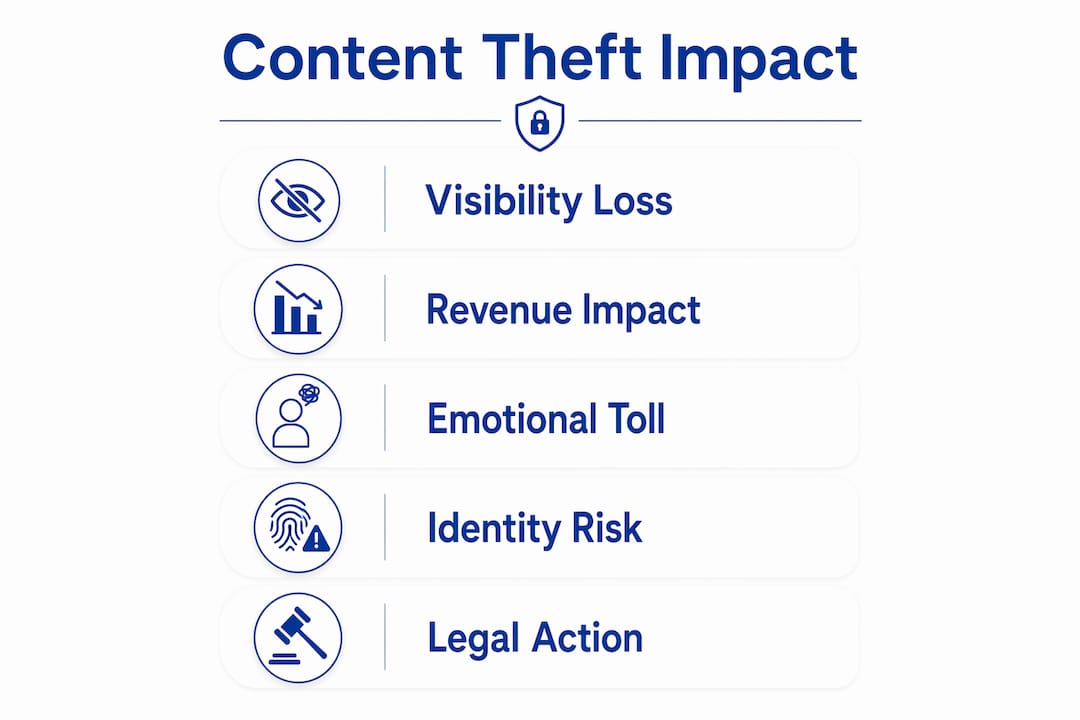
The emotional toll is real, too. Discovering that someone is profiting from your work, or worse, using your likeness to deceive your audience, feels like a gut punch. Creators report anxiety, reduced motivation, and a sense of helplessness that affects their output and their mental health. Recognizing that these feelings are a normal response to a genuine violation is the first step toward addressing it with clarity.
How can creators detect and document content theft effectively?
Detection starts with knowing where to look and what to look for. Suspicious accounts that post high volumes of content without original captions, lack a consistent posting history, or show sudden follower spikes are worth investigating. Missing attribution on content that looks like yours is the clearest signal.
Follow this workflow to build a solid evidence record:
- Search for your content. Use reverse image search tools for photos and platform-specific copyright match features for video. Search your username, brand name, and distinctive phrases from your captions.
- Capture the URL immediately. Copy the full URL of the infringing post before doing anything else. Posts can disappear within minutes once a thief suspects they have been spotted.
- Take timestamped screenshots. Screenshot the post, the account profile, and any engagement metrics visible. Timestamps prove the content existed at a specific point in time.
- Record engagement data. Note the view count, likes, and comments. This data supports your claim of harm when filing a DMCA notice or pursuing legal action.
- Organize your evidence folder. Keep a dedicated folder with all screenshots, URLs, and notes organized by date and platform. Treat it like a legal file, because it may become one.
Pro Tip: Never publicly call out a thief before your evidence is secured. Public callouts cause infringers to delete posts and destroy proof, making DMCA filings and legal action far harder to pursue.
You can also set up ongoing monitoring through brand mention alerts, hashtag tracking, and content theft monitoring tools that scan platforms automatically. Reactive detection is better than nothing, but proactive monitoring is what separates creators who protect their work from those who are always playing catch-up.
What legal and platform-based remedies exist for content theft?
The DMCA is your primary legal tool in the United States. Filing a DMCA takedown notice is the fastest legal remedy available, and most infringing content is removed within 48 hours of a valid notice being received. A valid notice must include a description of your copyrighted work, the URL of the infringing content, your contact information, and a statement made under penalty of perjury that you are the rights holder.
Platform-specific processes vary, but the core steps are consistent:
- Facebook and Instagram. Use Meta’s Rights Manager or the in-app reporting tool to flag unauthorized content. A DMCA takedown on Facebook follows a structured review process that typically resolves within a few days.
- TikTok. Report through the app’s copyright infringement form. TikTok’s review team handles most cases within 48–72 hours.
- YouTube. Content ID catches many violations automatically. For content that slips through, a manual copyright strike request is available.
- X (formerly Twitter). Submit a copyright complaint through X’s dedicated form. Sidenty’s guide on filing a takedown on X walks through each step in detail.
| Remedy | Best for | Typical timeframe |
|---|---|---|
| DMCA takedown notice | Direct copyright violations | 24–48 hours |
| Platform copyright report | In-app violations | 48–72 hours |
| Google delisting request | Search result removal | 7–14 days |
| Legal counsel | Repeat infringers, large damages | Weeks to months |
Registering your copyright with the U.S. Copyright Office before infringement occurs strengthens your legal position significantly. It allows you to pursue statutory damages rather than proving actual financial harm, which is often difficult to quantify precisely.
What strategies can creators use to prevent content theft?
Prevention reduces the volume of theft you have to respond to. No single measure eliminates the risk, but combining several creates meaningful friction for would-be thieves.
- Watermark your content. Place your handle or logo in a location that is difficult to crop out without degrading the visual quality of the content.
- Embed metadata. Add copyright information to the metadata of image and video files before publishing. This data travels with the file and can help establish ownership.
- Clarify usage rights in contracts. Creators must explicitly outline usage and sublicensing rights in any agreement with affiliates, brand partners, or collaborators. Ambiguous contracts create legal standoffs that benefit no one.
- Choose platforms with stronger enforcement records. Platforms prioritize growth over proactive content protection, so understanding each platform’s enforcement infrastructure before you commit your best content there is a practical business decision.
- Build monitoring into your weekly workflow. Schedule 30 minutes each week to run searches, check alerts, and review your evidence folder. Treating content protection as a routine business task, not a crisis response, keeps you ahead of most violations.
Creators who protect their digital identity and privacy proactively report fewer incidents and recover faster when violations do occur. Prevention is not about being paranoid. It is about being professional.
Key Takeaways
Social media content theft is a legal violation with measurable financial consequences, and creators who treat protection as a structured business workflow recover faster and lose less.
| Point | Details |
|---|---|
| Content theft is a legal violation | Unauthorized reposting, editing, or streaming of your content breaches copyright law under the DMCA. |
| Financial losses are significant | Creators lose 30–50% of potential income from unauthorized distribution annually. |
| Evidence must come before action | Capture URLs, screenshots, and timestamps before reporting or confronting an infringer publicly. |
| DMCA notices work fast | Most platforms remove infringing content within 48 hours of receiving a valid DMCA notice. |
| Prevention requires routine monitoring | Weekly searches, watermarks, and clear contracts reduce theft risk more than reactive enforcement alone. |
The consent problem nobody in the creator economy wants to address
Working with creators navigating content theft every day, the pattern that stands out most is not the theft itself. It is the shock. Creators are consistently surprised that platforms do not protect them automatically. The assumption is that if you post original content, the platform has your back. That assumption is wrong.
Platforms are built to maximize engagement and user growth. Content protection is a secondary concern, addressed reactively when legal pressure demands it. Image and still-frame theft, in particular, remains severely underprotected because content ID systems were designed for video. A photo stolen and reposted 500 times generates no automatic flag.
The shift from simple copyright violations to AI-enabled identity theft has made this worse. When someone can generate a convincing video of you endorsing a product you have never heard of, the harm is no longer just financial. It is reputational and personal. Traditional DMCA enforcement was not built for that scenario, and waiting for platforms to solve it is not a strategy.
What actually works is treating content protection as a business function with repeatable processes, clear documentation standards, and a willingness to escalate quickly. Creators who approach enforcement professionally, with organized evidence and a clear understanding of the legal tools available, get results. Those who react emotionally, or wait too long, often find that the evidence has vanished along with the infringing post.
The uncomfortable truth is that protecting your work is your responsibility. Platforms will not do it for you. But with the right workflow and the right support, you can make theft costly enough that most bad actors move on.
— Sidenty
Sidenty’s protection services for creators facing content theft
Discovering your content on an unauthorized account is a gut punch. Knowing exactly what to do next is what separates creators who recover quickly from those who spend weeks chasing dead ends.
Sidenty specializes in copyright infringement removal and digital identity protection for creators on platforms including OnlyFans, Twitch, TikTok, and beyond. With a 99.8% success rate in content removal, Sidenty combines advanced detection technology with a dedicated legal team to handle DMCA takedowns, deepfake removal, and Google delisting on your behalf. If your content or likeness has been used without your consent, Sidenty’s team is ready to act. Visit Sidenty to get personalized support and put the power back in your hands.
FAQ
What is social media content theft exactly?
Social media content theft is the unauthorized use, reposting, or redistribution of a creator’s original content on social platforms without permission or credit. It is a copyright violation under U.S. law and enforceable through the DMCA.
Why is content theft illegal?
Content theft violates copyright law because original creative works are protected from the moment of creation. Reproducing or distributing them without the rights holder’s permission is an infringement, regardless of whether the thief profits from it.
What is live stream recording theft?
Live stream recording theft occurs when someone records a creator’s live broadcast and redistributes that recording on other platforms without authorization. The recorded content retains the original creator’s copyright protection.
How do I prevent content theft on social media?
Watermark your content, embed copyright metadata in your files, clarify usage rights in all contracts, and run weekly monitoring searches. No single measure eliminates risk, but combining them creates meaningful deterrence.
How fast does a DMCA takedown work?
Most platforms remove infringing content within 48 hours of receiving a valid DMCA takedown notice. The notice must include the infringing URL, a description of your original work, and a statement under penalty of perjury confirming your rights.