
Social media identity fraud is the unauthorized use of your personal information, photos, or online presence on social networks to impersonate you or commit financial crimes. This is the industry’s broader term for what most people call social media identity theft, and the distinction matters. Identity theft on social media encompasses both account hacking and the misuse of publicly visible data to defraud others in your name. 21% of all digital fraud attempts in high-usage regions involve social media identity theft. That figure means roughly one in five fraud cases starts with a social profile. Social platforms are uniquely dangerous because they combine free access, open personal data, and constant updates in one place.
What is social media identity fraud and how does it work?
Social media platforms are the primary vectors for identity fraud because they store names, photos, birthdays, workplaces, and relationship data in one publicly accessible location. Criminals do not need to hack a database to steal your identity. They can piece together enough information from your public profile alone to cause serious harm.
The core mechanism is simple. A fraudster collects your data, constructs a false version of you, and then uses that version to deceive others or access financial accounts. The damage spreads fast because social networks connect you to hundreds of people who trust your name and face.
What methods do criminals use to commit this type of fraud?
Criminals use several well-documented tactics to carry out identity fraud on social networks. Knowing each one helps you spot the warning signs early.
- Phishing pages: Fraudsters build fake login pages that look identical to Facebook, Instagram, or LinkedIn. You click a link, enter your credentials, and hand them direct access to your account.
- Fake profile creation: Fake profiles built from stolen photos and personal details are one of the most common tactics. The fraudster then contacts your friends, requests money, or spreads misinformation under your identity.
- Data aggregation: Your birthday is on Facebook. Your employer is on LinkedIn. Your pet’s name is in an Instagram caption. Criminals aggregate these public data fragments to answer knowledge-based security questions at banks and financial institutions. No hacking required.
- Social engineering: A fraudster poses as a trusted contact or brand representative to manipulate you into sharing passwords, verification codes, or sensitive documents.
- AI-powered biometric cloning: This is the newest and most alarming method. Criminals use audio or video clips from your public posts to clone your voice or face with AI tools.
Pro Tip: Search your own name and profile photo on Google Images every few months. If a fake account is using your picture, you will find it before your contacts do.
The aggregation tactic deserves special attention because most people underestimate it. You may never post your full address or Social Security number, but the combination of smaller details you share freely can be just as dangerous.
What are the risks and consequences of social media identity fraud?
The consequences of identity fraud on social networks reach far beyond a hacked account. They affect your finances, your relationships, and your reputation simultaneously.
- Financial fraud: A criminal impersonating you can request emergency loans from your contacts, open credit lines using your aggregated data, or redirect payments meant for you.
- Reputational damage: A fake profile posting offensive content under your name can destroy professional relationships before you even know the account exists.
- Emotional harm: Discovering that someone is living as you online is a gut punch. The sense of violation and helplessness is real and documented.
- Business risk: For content creators and entrepreneurs, account hijacking can mean losing a monetized channel, a verified profile, or years of built audience trust overnight.
- Legal exposure: If a fraudster commits crimes using your identity, you may need to prove your innocence to law enforcement or financial institutions.
The reputational risk is especially severe for public figures and content creators. A deepfake video or a convincing fake profile can spread to thousands of followers before any platform takes it down. The cybersecurity and identity fraud research community now treats biometric impersonation as a top-tier threat precisely because the damage is so hard to reverse.
How can you protect yourself from social media identity fraud?
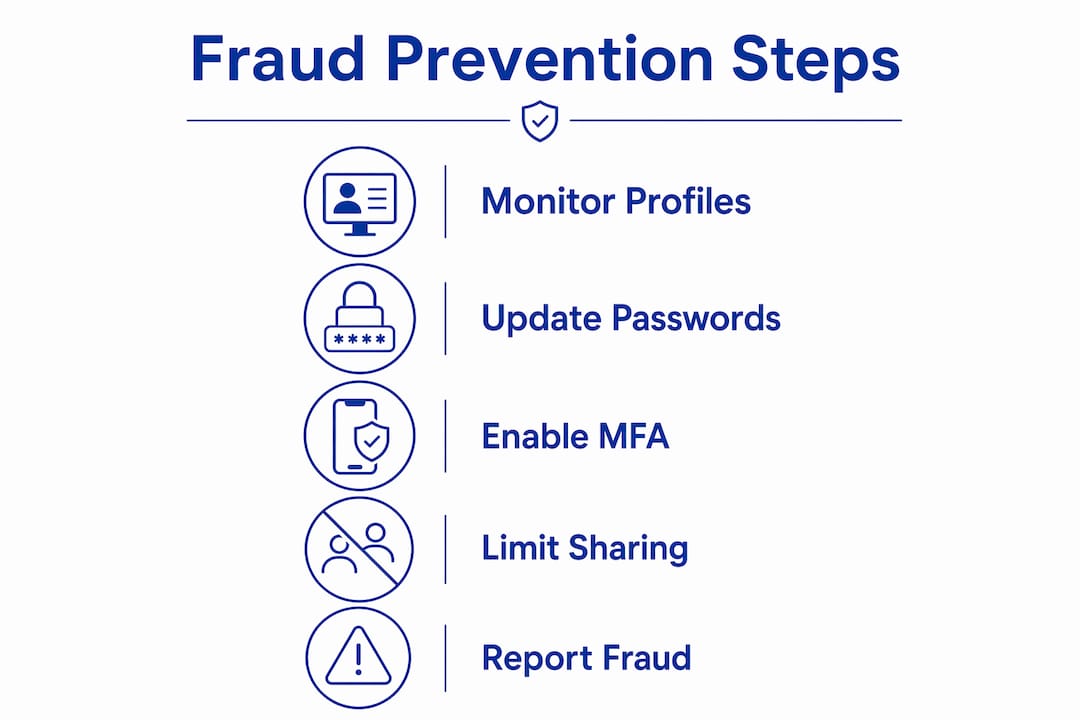
Protection against social media identity theft requires layered defenses. No single step is enough on its own.
- Use unique, complex passwords for every account. A password manager generates and stores them so you never reuse credentials across platforms.
- Enable multi-factor authentication (MFA). MFA requires a second verification step beyond your password, blocking most unauthorized login attempts even when credentials are stolen.
- Audit your privacy settings. Set your social profiles to “friends only” or the most restrictive option available. Review what is publicly visible, including your birthday, phone number, and location tags.
- Limit what you share publicly. Avoid posting your full birthdate, home address, or answers to common security questions (your first car, your mother’s maiden name, your high school). These details fuel data aggregation attacks.
- Verify unexpected messages. If a contact asks for money or personal information through social media, call them directly before responding. Social engineering attacks rely on urgency and trust.
- Monitor your accounts regularly. Check for login activity you do not recognize. Most platforms show recent sessions under security settings.
- Use identity protection services. Specialized services scan for fake profiles, unauthorized use of your images, and leaked personal data across the web.
Pro Tip: Review your privacy checklist for creators at least once per quarter. Platform privacy settings change frequently, and defaults often favor visibility over protection.
A multi-layered defense combining strong passwords, MFA, and financial monitoring is the most effective baseline protection against identity fraud. Each layer compensates for the weaknesses of the others.
What steps should you take if you discover social media identity fraud?
Speed matters when you find evidence of fraud. Every hour a fake profile or stolen account stays active, the damage compounds.
- Change your passwords immediately. Start with the compromised account, then update any account that shares the same password.
- Enable MFA on all accounts if you have not already done so.
- Report the fake profile or fraudulent activity directly to the platform. Facebook, Instagram, LinkedIn, and X all have dedicated reporting flows for impersonation. Sidenty’s guide on removing a fake Facebook account walks through the exact steps.
- Alert your contacts. Post a clear notice on your real account warning friends that a fake profile exists. This stops the fraudster from successfully scamming people who trust your name.
- Document everything. Screenshot the fake profile, fraudulent messages, and any financial transactions before reporting. This evidence supports legal action later.
- Monitor your credit reports and financial accounts for unauthorized activity. Identity fraud on social networks frequently leads to financial fraud within days.
Standard remediation for social media impersonation includes these exact steps, and legal advice becomes necessary when defamation or financial loss is involved.
| Step | Action | Priority |
|---|---|---|
| Change credentials | Update passwords and enable MFA | Immediate |
| Report to platform | Submit impersonation report with evidence | Immediate |
| Notify contacts | Warn your network about the fake account | Within 24 hours |
| Document evidence | Screenshot all fraudulent content | Before reporting |
| Monitor finances | Check credit reports and bank statements | Ongoing |
How is AI changing the threat of social media identity fraud?
AI has moved identity fraud from a nuisance to a serious security crisis. The tools available to criminals today require no technical expertise and produce convincing results in minutes.
- Voice cloning in under 60 seconds: AI-driven biometric theft allows criminals to clone a human voice using just a short audio clip from a public social media post. That cloned voice can then be used to impersonate you in phone calls or audio messages.
- Facial deepfakes: Video clips from your public profiles provide enough data for AI tools to generate realistic video of you saying or doing things you never did.
- Freely available biometric data: Facial and voice biometrics are freely shared on social media and are far more vulnerable to AI cloning than fingerprint data, which is stored securely offline.
- Detection challenges: AI-generated media is increasingly difficult to distinguish from real content, even for trained reviewers. Platforms are still catching up with detection technology.
- Scalable attacks: AI tools allow one fraudster to run impersonation campaigns against dozens of targets simultaneously, something that was impossible with manual methods.
“The most dangerous shift in social media identity fraud is not the sophistication of the tools. It is the speed. A criminal can clone your voice, build a fake profile, and contact your entire network before you wake up in the morning. The window for prevention is shrinking, and the window for remediation is narrowing just as fast.”
Sidenty’s investigation into how deepfake networks operate shows exactly how organized these operations have become. This is not opportunistic crime. It is systematic.
Key Takeaways
Social media identity fraud is the leading form of digital impersonation, and AI-powered biometric cloning has made it faster and harder to detect than ever before.
| Point | Details |
|---|---|
| Definition matters | Social media identity fraud includes both account hacking and misuse of public data, not just password theft. |
| Data aggregation is the primary risk | Publicly visible fragments like birthdays and employers combine to bypass bank security questions. |
| MFA is non-negotiable | Multi-factor authentication blocks most unauthorized logins even when passwords are compromised. |
| AI cloning is a real, immediate threat | Voice and facial data shared publicly can be cloned by AI in under 60 seconds. |
| Speed of response determines damage | Reporting fake profiles and alerting contacts within 24 hours limits the spread of fraud significantly. |
What I’ve learned from watching identity fraud evolve
The most common misconception I see is that identity theft only happens after a hack. People assume that if their password is safe, their identity is safe. That assumption is wrong, and it is costing people dearly.
The real risk is the data you share voluntarily. Your birthday, your employer, your pet’s name, your high school. Each piece seems harmless. Together, they form a complete enough picture for a criminal to impersonate you to a bank, a landlord, or your own family. Most people have never audited what their public profile actually reveals.
The second thing I have learned is that behavioral defenses matter as much as technical ones. MFA and strong passwords are table stakes. But the habit of verifying unexpected requests, questioning urgency, and limiting what you post publicly is what actually stops attacks before they start.
AI has changed the calculus entirely. Biometric cloning used to require expensive equipment and expertise. Now it requires a short video clip and a free tool. The people most at risk are those who post the most, which often means content creators and public figures. Protecting your biometric data is no longer optional. It is a core part of digital security.
The good news is that awareness and consistent habits close most of the gap. You do not need to disappear from social media. You need to be deliberate about what you share and fast when something goes wrong.
— Sidenty
How Sidenty protects your digital identity
Discovering that someone is using your face, your name, or your content without permission is one of the worst feelings in digital life. You should not have to fight that battle alone.

Sidenty specializes in digital identity protection for individuals and content creators, with a 99.8% success rate in content removal. From fake profile takedowns to deepfake removal and DMCA enforcement, Sidenty’s team of legal experts handles the process so you can focus on your work. If your image, voice, or content has been misused on any platform, Sidenty provides the tools and expertise to get it removed fast and keep it from happening again.
FAQ
What is the difference between identity theft and identity fraud?
Identity theft is the unauthorized collection of your personal information. Identity fraud is the use of that stolen information to commit crimes, such as opening credit accounts or impersonating you online.
What are the most common signs of identity fraud on social media?
Common signs include friend requests from a duplicate profile using your photos, messages from your contacts asking about requests you never sent, and unexpected login alerts from unfamiliar locations.
How do criminals use public social media data to commit fraud?
Criminals aggregate small public details like your birthday, employer, and hometown to answer knowledge-based security questions at banks, bypassing authentication without ever hacking your account.
Can AI really clone my voice from a social media post?
Yes. AI-driven biometric tools can clone a human voice in under 60 seconds using a short audio clip from a public post, then use that voice to impersonate you in calls or messages.
How do I report a fake social media profile impersonating me?
Report the profile directly through the platform’s impersonation reporting tool, document all evidence with screenshots, and alert your contacts immediately to prevent further scams.