
Content protection technology is defined as the set of tools, standards, and legal mechanisms that prevent unauthorized access, copying, and distribution of digital work. For content creators and digital influencers, this is not an abstract concern. Your videos, photos, and written work represent real income, real reputation, and real identity. Holland & Knight’s Technology and Cybersecurity practice frames content protection explicitly around preserving innovations, intellectual property development efforts, and market position. Understanding why content protection technology matters starts with recognizing that the threat is not just hacking. It includes deepfakes, leaks, unauthorized sharing, and identity theft.
Why content protection technology matters in 2026
Content protection is no longer optional for creators who publish online. The risks have expanded well beyond someone screenshotting your post. Deepfake technology can place your face in content you never created. Leaked videos can circulate across dozens of platforms within hours. Your digital identity is as much an asset as your content itself.
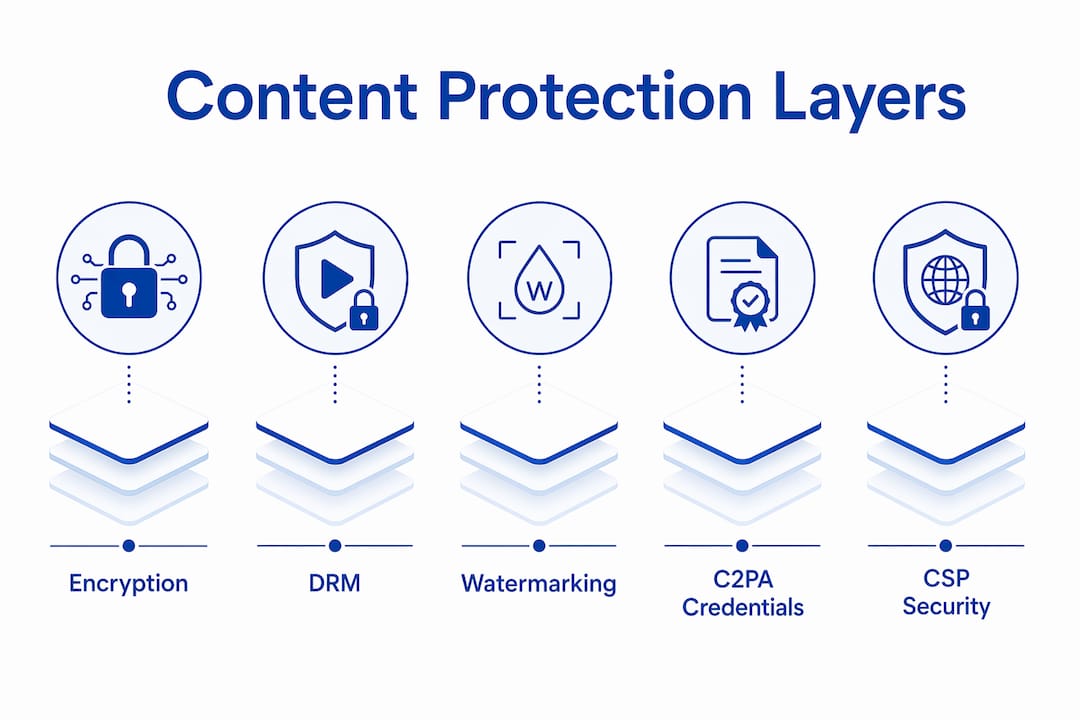
The core technologies protecting creators in 2026 are encryption, Digital Rights Management (DRM), forensic watermarking, Content Credentials (C2PA), and Content Security Policy (CSP). Each addresses a different attack surface. No single tool covers everything, which is exactly why understanding each one matters.

Protecting your intellectual property requires knowing which tool applies to which threat. A creator who understands encryption, DRM, and provenance metadata is far harder to exploit than one who relies on platform terms of service alone.
How does encryption protect your digital content?
Encryption converts your data into unreadable ciphertext that only authorized users can access with the correct key. Egnyte describes encryption as transforming data so that even if attackers breach a system, the exposed files remain useless without the decryption key. That is the key insight: encryption limits damage after a breach, not just before one.
For creators, encryption applies in several practical ways:
- Files at rest: Encrypt stored content on cloud drives and local devices so unauthorized access yields nothing readable.
- Files in transit: Use HTTPS and end-to-end encrypted transfer tools when sending content to collaborators or platforms.
- Regulatory compliance: Encryption supports GDPR and SOC 2 requirements, which matter if you collect subscriber data or work with brand partners.
- Subscriber data protection: Encrypting payment and personal data protects both you and your audience from exposure.
Encryption does not prevent someone from sharing a file they already have legitimate access to. That is where DRM takes over.
Pro Tip: Always verify that the platforms you upload to use encryption at rest. If a platform does not publicly document its encryption practices, treat that as a red flag.
What role do DRM and forensic watermarking play?
Digital Rights Management (DRM) is the technology that controls how content is accessed, copied, and distributed after delivery. DRM neutralizes most digital piracy vectors at scale by restricting playback to authorized devices and preventing direct file downloads. If someone cannot download your video file, they cannot easily redistribute it.
The limitation of DRM is physical recording. Someone can point a phone at a screen and record your content without ever touching the file itself. That is where forensic watermarking fills the gap.
Forensic watermarking embeds an invisible, unique identifier into each copy of your content. When a leak appears, the watermark traces it back to the specific account or session that recorded it. AI-assisted detection can identify these watermarks within hours, even in degraded recordings.
Here is how DRM and watermarking divide the work:
| Threat type | Primary defense | How it works |
|---|---|---|
| Direct file download | DRM | Blocks unauthorized file access at the platform level |
| Screen recording or phone filming | Forensic watermarking | Embeds unique ID traceable to the source session |
| Unauthorized redistribution | DRM + enforcement | Restricts playback and supports DMCA takedown actions |
| Leak attribution | Forensic watermarking | Identifies the specific user who leaked the content |
The most effective approach combines both. DRM stops the majority of piracy attempts. Watermarking handles the cases DRM cannot reach.
Pro Tip: When choosing a video hosting platform, ask specifically whether it offers per-user forensic watermarking, not just visible watermarks. Visible watermarks are easy to crop out. Forensic watermarks survive editing.
How do C2PA content credentials verify authenticity?
The Coalition for Content Provenance and Authenticity (C2PA) is an industry standard that embeds cryptographically signed metadata directly into media files. Adobe and SSL.com describe C2PA as creating tamper-evident Content Credentials that record the creator, the tools used, the time of creation, and any edits made. This provenance chain travels with the file through export and publication.
For creators, C2PA serves two purposes. First, it proves your work is original and documents your authorship. Second, it helps audiences verify that content attributed to you actually came from you, which matters enormously in an era of AI-generated deepfakes.
The practical workflow for preserving provenance looks like this:
- Capture content using a C2PA-compatible camera or device.
- Edit using software that preserves and updates the C2PA manifest, such as Adobe Photoshop or Lightroom.
- Export with credentials intact and publish to platforms that display Content Credentials.
- Verify your own credentials using the Content Authenticity Initiative’s public verification tool before publishing.
C2PA has real limitations that creators must understand. C2PA manifests can be removed or stripped during file conversion or platform processing. The absence of credentials does not confirm that content is fake or AI-generated. It only means the provenance chain is not present. Treat C2PA as documented history, not a guarantee of authenticity.
UK government research on deepfake detection confirms that deepfake detection remains an evolving challenge. Watermarking and provenance metadata are among the most reliable methods available, but no single approach is foolproof. Creators who combine C2PA with watermarking give themselves the strongest foundation.
Why does a multi-layered approach to content security work best?
Piracy is adaptive. A multi-layered anti-piracy strategy is necessary because no single protection method addresses all risks. When one control fails or gets bypassed, the next layer catches what slipped through. This is the same logic that security professionals apply to network defense.
A practical layered strategy for creators combines four elements:
- Encryption at rest and in transit to protect files from unauthorized access.
- DRM on video and audio content to block direct downloads and restrict playback.
- Forensic watermarking to trace leaks that bypass DRM through physical recording.
- Content Security Policy (CSP) on your website or storefront to block malicious script injections.
CSP deserves more attention from creators who run their own websites. CSP is a web browser standard that restricts which scripts and resources a browser loads on your site. It prevents cross-site scripting (XSS) attacks, which can be used to steal subscriber data or hijack your platform. If you sell content directly through your own site, CSP is a non-negotiable protection.
The balance between security and user experience matters too. Overly aggressive DRM frustrates legitimate subscribers and drives them away. The goal is to make unauthorized access difficult while keeping the experience smooth for paying customers. Advanced anti-piracy solutions that combine technical controls with enforcement actions strike this balance better than any single technical measure alone.
Pro Tip: If you manage your own website, ask your developer to run a CSP audit. Many creator sites have no CSP headers at all, leaving them open to script injection attacks that can compromise your entire subscriber database.
Key Takeaways
Content protection technology works because layered defenses combining encryption, DRM, watermarking, C2PA provenance, and CSP address the full range of threats that no single tool can cover alone.
| Point | Details |
|---|---|
| Encryption limits breach damage | Encrypt files at rest and in transit so stolen data remains unreadable without the key. |
| DRM plus watermarking covers more ground | DRM blocks direct downloads; forensic watermarking traces leaks from physical recordings. |
| C2PA proves authorship | Content Credentials document creation history but can be stripped, so treat them as evidence, not proof. |
| CSP protects your platform | Content Security Policy blocks script injections on creator websites and storefronts. |
| Layered defense is the standard | Combining multiple controls and enforcement actions is the only approach that keeps pace with adaptive piracy. |
The uncomfortable truth about content protection I’ve learned
Most creators I talk to think about content protection only after something goes wrong. A video leaks. A deepfake appears. Someone files a false DMCA claim against their own work. By that point, the damage is already spreading.
The uncomfortable truth is that content protection is a business risk issue, not just a tech issue. Holland & Knight’s framing of IP protection as market position preservation resonates with me because it reframes the conversation. You are not just protecting files. You are protecting your income stream, your audience’s trust, and your ability to keep creating.
The other thing I have learned is that technology has limits. C2PA credentials get stripped. DRM gets bypassed by a phone pointed at a screen. Encryption does nothing once someone with legitimate access decides to leak your content. That is why enforcement matters as much as technology. Filing DMCA notices, pursuing Telegram DMCA takedowns, and working with professionals who know how to trace leaks are not backup plans. They are part of the primary strategy.
Early adoption of these tools also builds audience trust in ways that are hard to quantify but very real. When your audience knows you take your content and their data seriously, they stay subscribers longer. That is a business outcome, not just a security outcome.
— Jordy
How Sidenty protects creators from leaks and deepfakes
Discovering that your content has been leaked or that a deepfake of you is circulating online is a gut punch. Knowing what to do next makes all the difference.
Sidenty specializes in digital identity protection and intellectual property enforcement for content creators on platforms including OnlyFans and Twitch. With a 99.8% success rate in content removal, Sidenty combines advanced detection technology with a dedicated legal team to remove unauthorized content fast. Services cover deepfake removal, DMCA enforcement, and leak takedowns across platforms. If your content is already out there, Sidenty’s team knows exactly how to get it down and keep it down.
FAQ
What is content protection technology?
Content protection technology is the combination of encryption, DRM, watermarking, provenance standards like C2PA, and web security controls like CSP that prevent unauthorized access, copying, and distribution of digital work.
Why is DRM not enough on its own?
DRM blocks direct file downloads but cannot stop physical screen recordings. Forensic watermarking is required to trace leaks that originate from phone-filmed recordings, which DRM cannot prevent.
What does C2PA do for content creators?
C2PA embeds cryptographically signed metadata into media files, recording the creator, tools used, and edit history. This documents authorship and helps audiences verify that content attributed to you actually came from you.
How does a deepfake threaten a creator’s identity?
A deepfake places a creator’s face or voice into content they never produced, which can damage reputation, mislead audiences, and cause direct financial harm. Deepfake detection remains an evolving challenge, making proactive protection critical.
What is the fastest way to respond to a content leak?
File a DMCA notice with the hosting platform immediately, document the infringing URLs, and contact a professional service like Sidenty that can pursue leaked content removal across multiple platforms simultaneously.